


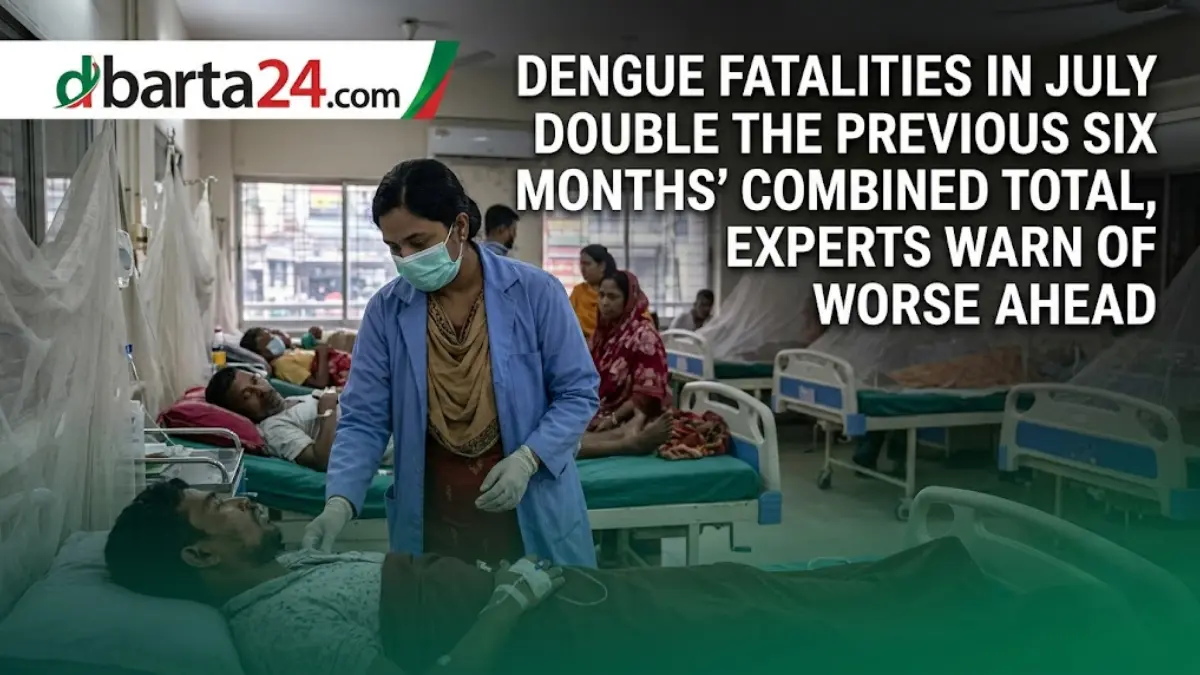
Khairul Alam; Dbarta24 – Bangladesh is facing a staggering surge in dengue cases, with fatalities in July alone more than doubling the combined death toll of the preceding six months.
Public health experts and entomologists have raised alarms that the outbreak could intensify and prolong from August through October due to shifting weather patterns and the emergence of a new dominant virus strain.
According to the Directorate General of Health Services (DGHS), three more dengue-related deaths and 467 new hospitalizations were recorded in the 24 hours leading up to Thursday morning.
This brings the total number of hospital admissions this year to 15,157, with the death toll reaching 53.
The July Surge: Data Analysis
A closer look at official data reveals a sharp and worrying trajectory. Between January and June, Bangladesh recorded 18 dengue deaths (two each in January and February, one in May, and 13 in June).
However, the situation escalated drastically in July, which saw 35 deaths and 9,053 infections in just 30 days.
July alone accounted for 59.52% of total infections and 66.3% of all dengue fatalities recorded this year.
Currently, 1,169 patients remain under treatment in various hospitals across the country, while 13,931 have been discharged after recovery.
Unfavorable Weather and Lack of Preparation
Public health specialists point out that the official dengue season has only just begun, and the rapid deterioration is linked to inadequate vector control measures.
“The upward trend in infections and deaths in July proves that the necessary preparations to control dengue were lacking,” warned public health expert Professor Be-Nazir Ahmed. “If effective measures are not taken immediately, the situation could become even more fragile in the coming months.”
Entomologist Professor Kabirul Bashar explained that continuous rainfall in the previous month, followed by specific weather conditions, has created an ideal breeding ground for Aedes mosquitoes.
“Usually, the mosquito population increases significantly at least two months after heavy rains. Consequently, dengue transmission could remain at a high level through August, September, and even October,” Professor Bashar noted.
The Threat of the Den-3 Serotype
The Institute of Epidemiology, Disease Control and Research (IEDCR) has identified a shift in the dominant dengue virus strain this year, detecting a predominance of the Den-3 serotype.
Dr. Mohammad Shafiul Alam, a scientist at icddr,b, noted that the Den-2 serotype was dominant between 2023 and 2025. The resurgence of Den-3 poses a severe risk to the population.
Medical experts emphasize that when an individual previously infected with one serotype becomes infected with a different strain, the risk of developing severe dengue hemorrhagic fever or dengue shock syndrome increases exponentially, significantly raising mortality risks.
Rising Risks Outside Dhaka
While Dhaka historically bore the brunt of the virus, the risk is shifting rapidly to peripheral districts. This year, the Barisal division has registered the highest number of dengue cases outside the capital.
Experts have flagged several high-risk districts, including Barisal, Barguna, Pirojpur, Patuakhali, Bagerhat, Khulna, Chattogram, Cox’s Bazar, Chandpur, Cumilla, Dhaka, Gazipur, Mymensingh, Narsingdi, Manikganj, Munshiganj, and Narayanganj.
Professor Be-Nazir Ahmed added that the widespread transmission outside the capital, combined with the new serotype, complicates clinical management and heightens fatality risks due to limited medical infrastructure in rural areas.
Integrated and immediate vector control intervention remains the only viable path to curb the outbreak.
Historical data underscores the cyclical severity of the disease. While Bangladesh recorded 102,861 cases and 413 deaths last year, and 101,214 cases with 575 deaths in 2024, the country experienced its worst-ever outbreak in 2023, with over 321,000 hospitalizations and 1,705 lives lost.
Observers fear that without immediate civic and administrative intervention, the current year could head toward a similarly catastrophic trajectory.