


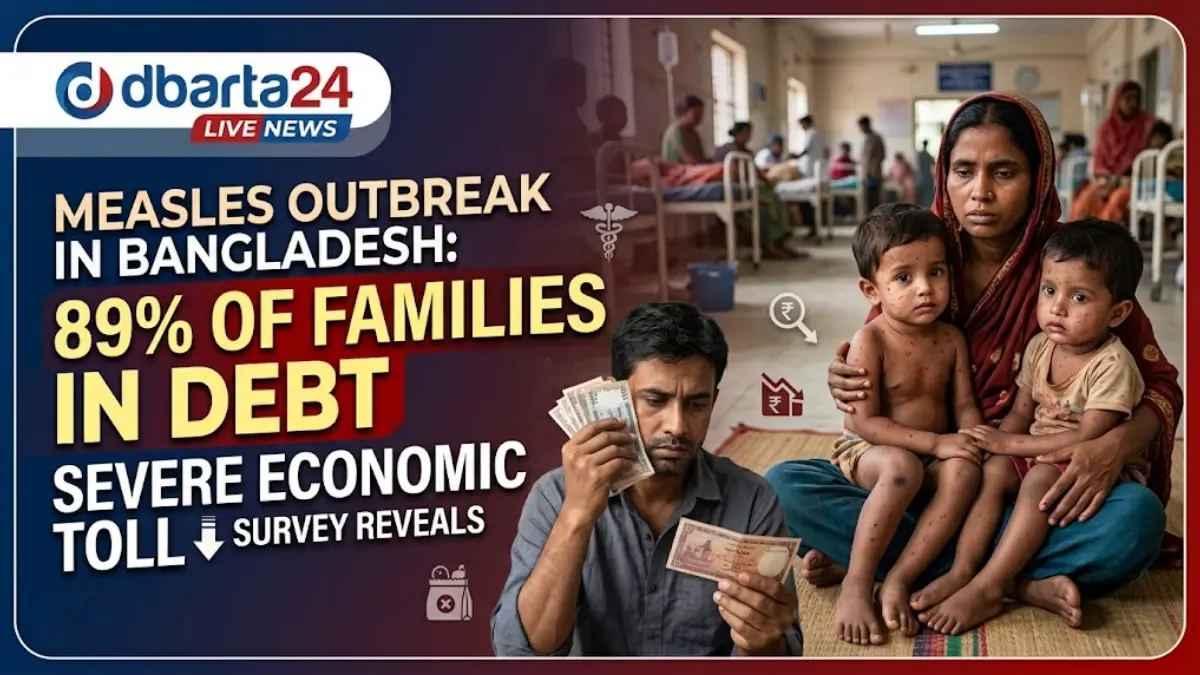
Khairul Alam; Dbarta24 — The ongoing measles outbreak in Bangladesh has expanded beyond a public health emergency, triggering severe financial devastation for low-income households.
Despite medical care being free at state facilities, an astounding 89 percent of affected families were forced to borrow money to cover indirect expenses—including medicines, diagnostic tests, transport, and food—according to a joint survey by the Bangladesh Red Crescent Society (BDRCS) and the International Federation of Red Cross and Red Crescent Societies (IFRC).
The survey, released on Monday, analyzed data from 2,746 measles-affected families across 12 government medical college hospitals and district health centers nationwide.
Exhausted Savings and Devastating Wage Loss
Beyond debt accumulation, the assessment highlighted severe economic strain: 61 percent of families depleted their life savings to fund treatment, while 4 percent sold assets and 3 percent relied on charitable aid.
The financial crisis extends well beyond direct medical bills. Parents caring for hospitalized children were frequently forced to miss work, resulting in lost daily wages or complete income stoppage.
In some instances, workers in informal sectors—comprising 78 percent of primary earners in the survey—lost their jobs entirely due to prolonged absences.
On average, treatment and associated expenses cost BDT 15,611 per patient, with some severe cases escalating up to BDT 65,000.
The burden falls heavily on the most vulnerable; 72 percent of surveyed households earn less than BDT 15,000 monthly, with 12 percent living on under BDT 6,000 per month.
┌─────────────────────────────────────────────────────────┐
│              FINANCIAL IMPACT ON FAMILIES               │
├─────────────────────────────────┬───────────────────────┤
│ Took Loans / Debt               │ 89%                   │
│ Exhausted Personal Savings      │ 61%                   │
│ Sold Household Assets           │ 4%                    │
│ Relied on Humanitarian Aid      │ 3%                    │
└─────────────────────────────────┴───────────────────────┘
Children Under Four Suffer the Brunt
Demographic data reveals that infants and young children bear the heaviest disease burden. 75 percent of all affected patients were under four years old, 19 percent were aged 5 to 17, and only 6 percent were adults.
Geographically, the highest concentration of surveyed cases was reported from Dhaka (32%), followed by Chattogram (22%), Barishal (20%), and Mymensingh (18%).
The human toll is exemplified by Hajera Khatun from Rangpur, who traveled to Dhaka’s Shaheed Suhrawardy Medical College Hospital to treat her 11-month-old daughter.
“Even though treatment in government hospitals is free, ambulance fares, diagnostic tests, food, and other necessities cost us over BDT 70,000,” Khatun shared. “We had to borrow heavily from relatives, especially since my husband, an expatriate in Saudi Arabia, didn’t receive his wage that month.”
Emergency Relief and Expert Calls for Reform
In response to the findings, BDRCS and IFRC have selected 2,400 of the most vulnerable families to receive direct cash assistance of BDT 10,000 each.
BDRCS Secretary General Dr. Kabir M. Ashraf Alam emphasized that affected households are grappling with dual crises—health risks and deep financial distress.
Concurring, Alberto Bocanegra, Head of Delegation for IFRC in Bangladesh, stated: “The impact of measles reaches far beyond hospital walls. Caregivers lose vital income and fall into deep debt. Managing this crisis requires strong social protection mechanisms alongside emergency humanitarian aid.”
Public health experts stress that strengthening routine immunization programs and reducing out-of-pocket medical expenses are urgent priorities. Without structural safety nets, preventable disease outbreaks will continue pushing vulnerable families into long-term debt traps and extreme poverty.