


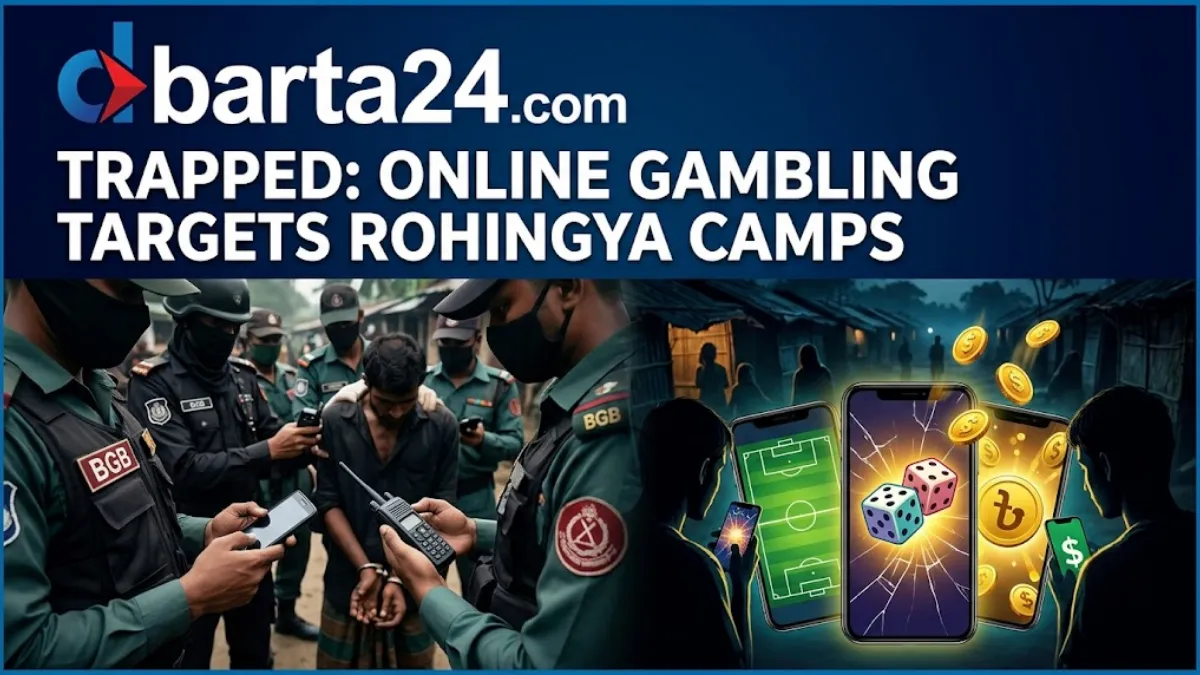
Local Correspondent ; Dbarta24 — Beyond drug trafficking, human smuggling, and contraband trade, a new threat is rapidly undermining security in Cox’s Bazar: organized online gambling.
What began as localized betting networks centered around Rohingya refugee camps has mutated into a sprawling digital racket across the district.
Promising easy money, these platforms are trapping teenagers, young adults, and working professionals in a cycle of addiction—leaving families in debt and feeding a surge in local crime.
Here is an in-depth breakdown of how the syndicate operates, recent law enforcement crackdowns, and its expanding fallout on local tourism.
The Three-Tiered Syndicate: How the Scam Operates
Investigative details reveal that the gambling network in the refugee camps functions through a structured three-tier system:
-
Master Agents: Oversee regional operations and interface with international digital betting platforms.
-
Agents: Handle money transfers, account creation, and localized distribution.
-
Sub-Agents: Recruits on the ground who actively pull refugees and local residents into the digital betting loop for commission.
In addition to established betting portals, fraudulent syndicates have created fake betting apps.
Operators build initial trust by allowing users to win small payouts. Once victims deposit substantial sums, the app shuts down or blocks user accounts, siphoning off millions of Taka.
“The Rohingya camps are practically floating on online gambling right now.”
— Md. Siraj Amin, Battalion Commander, 14th Armed Police Battalion (APBN)
Law Enforcement Strike: The Teknaf Crackdown
The scale of the operation came into sharp focus on the night of July 20, when Border Guard Bangladesh (BGB) launched a targeted operation in the Dailpara and Mondalpara areas of Teknaf’s Sabrang Union.
BGB personnel arrested nine members of an online gambling syndicate, including three Rohingya refugees, and seized nine mobile phones used to manage betting accounts.
According to Lieutenant Colonel Hanifur Rahman Bhuiyan, Commander of the Teknaf Battalion (2 BGB), the raid was the culmination of three months of covert intelligence gathering and technological tracking.
The syndicate had been actively mobilizing funds and making extensive preparations to handle massive betting volumes centered around the 2026 FIFA World Cup final.
From Camps to the City: Addiction Spreading to Youth and Tourism
The tentacles of online betting are no longer confined to refugee shelters. The addiction has deeply penetrated Cox’s Bazar city and nearby commercial hubs.
Young students frequently fall victim through social media promotions and influencer endorsements.
One local teenager from Nuniarchhara admitted he downloaded a betting application after seeing a popular celebrity promoting it online while he was still in eighth grade.
What started as small wagers quickly turned into a debilitating addiction.
The fallout has extended to the heart of Cox’s Bazar’s economy: its tourism and hospitality industry.
“The severe addiction to online gambling isn’t just affecting ordinary citizens; it is directly impacting our tourism sector. Several hotel managers in Cox’s Bazar have been completely ruined financially, and I know of at least one hotel owner who went bankrupt. Many drivers of tourist transport vehicles have also fallen into this trap.”
— Karim Ullah Kalim, General Secretary, Cox’s Bazar Hotel-Motel Officers’ Association
The Path Ahead
The convergence of economic vulnerability, easy smartphone access, and targeted digital marketing has created a volatile situation in Cox’s Bazar.
As law enforcement agencies intensify operations, experts urge that digital surveillance must be coupled with community awareness campaigns—particularly targeting youth and camp residents—to dismantle these cyber-crime networks before they further destabilize the region.