


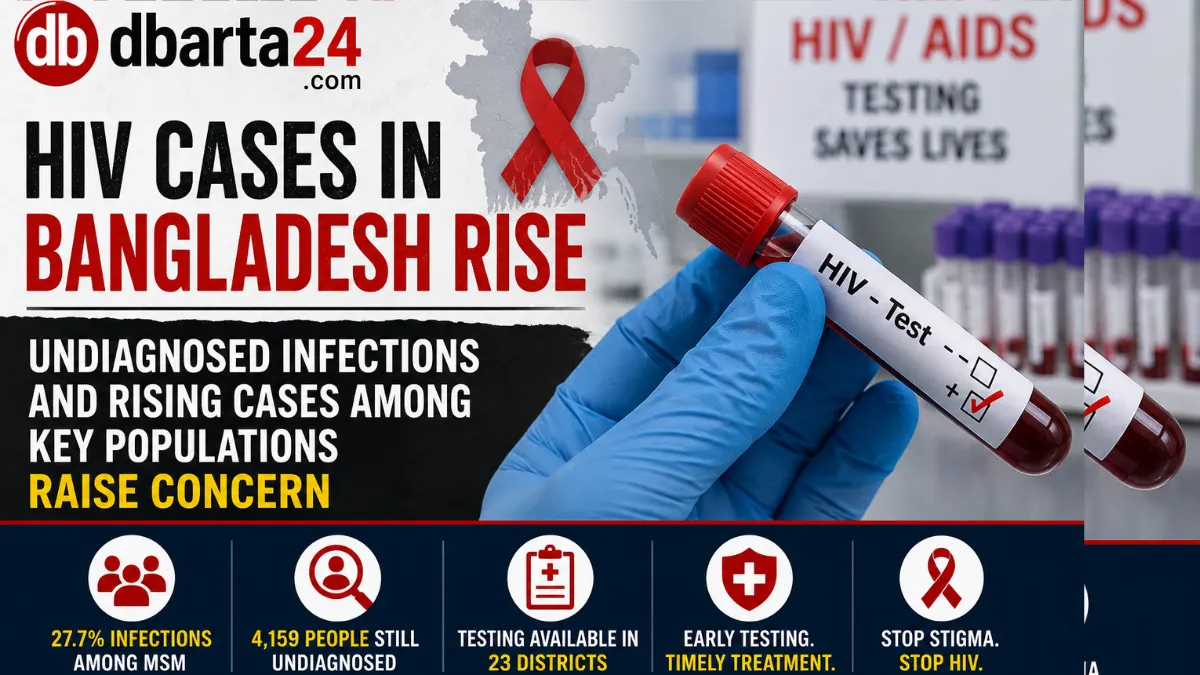
Khairul Alam ; Health Desk – Bangladesh is facing growing concern over HIV transmission as health experts warn that thousands of undiagnosed infections are helping spread the virus across the country.
Officials also report that infections remain concentrated among key populations, highlighting the need for wider testing, improved treatment access, and stronger public awareness campaigns.
According to the Directorate General of Health Services (DGHS), Bangladesh is estimated to have 15,143 people living with HIV. Of them, 10,984 have been diagnosed, leaving 4,159 people unaware of their HIV status.
Public health specialists say these undiagnosed cases pose one of the biggest challenges to controlling new infections because individuals who do not know they are infected are less likely to receive treatment or take preventive measures.
Majority of Patients Are Men
Data from the National AIDS/STD Programme shows that 75% of people living with HIV in Bangladesh are men, while 24% are women and 1% belong to the transgender (Hijra) community.
Among identified transmission categories, men who have sex with men (MSM) account for the largest share of infections at 27.7%. Other groups include:
- General population: 27%
- Migrant workers: 17.6%
- People who inject drugs: 13.1%
- Rohingya refugees: 12.4%
- Transgender community: 1.3%
- Female sex workers: 0.4%
Health experts say these figures underline the importance of targeted prevention programmes for populations at greater risk while ensuring services remain free from stigma and discrimination.
Experts Call for More Testing
Professor Dr. Mojaharul Haque, former adviser to the World Health Organization’s South-East Asia Region and former Director of the National Institute of Public Health, described the rising HIV infections among MSM as a matter of concern.
He said increasing awareness about HIV transmission, expanding counselling services, and improving public education are essential steps to reduce new infections.
Dr. Haque also noted that Bangladesh has committed to achieving the UNAIDS 95-95-95 targets by 2030. Under this global strategy:
- 95% of people living with HIV should know their status.
- 95% of diagnosed patients should receive treatment.
- 95% of those receiving treatment should achieve viral suppression.
He said Bangladesh has yet to reach these benchmarks and called for stronger coordination between the health and home ministries.
Limited Testing Facilities
Health officials say HIV testing services are currently available in 23 districts, while treatment is provided through 13 specialized centres.
The HIV response is supported by organizations including Save the Children, icddr,b, IEDCR and other partner agencies.
Their work includes HIV testing, identifying new cases, distributing condoms to reduce transmission risks, and supporting treatment programmes.
Officials, however, warned that reduced funding as the current health project nears completion has slowed some HIV prevention and response activities.
Progress and Challenges
Mohammad Aktaruzzaman, Senior Manager of the National AIDS/STD Programme, said nearly 39 million people worldwide are living with HIV.
He noted that Bangladesh detected its first HIV case in 1989. Of the estimated 15,143 people living with HIV in the country, about 73% have been diagnosed, while 75% of diagnosed patients are receiving treatment.
Among those receiving treatment, around 90% have achieved viral suppression, indicating that antiretroviral therapy is effective when patients remain in care.
He added that one of the biggest barriers to meeting international targets is the lack of HIV testing facilities in every district.
How HIV Spreads
Medical experts say HIV is transmitted through contact with certain body fluids, including blood, semen, vaginal fluids and breast milk. Common routes of transmission include:
- Unprotected sexual contact
- Sharing contaminated needles or syringes
- Receiving unscreened blood transfusions
- Transmission from mother to child during pregnancy, childbirth or breastfeeding
- Use of contaminated medical equipment in healthcare settings
HIV is not spread through casual contact such as handshakes, hugging, sharing food, or mosquito bites.
Preventing HIV Infection
Public health experts recommend several measures to reduce HIV transmission:
- Practice safer sex, including consistent condom use.
- Ensure all donated blood is screened before transfusion.
- Use sterile needles and medical equipment.
- Avoid sharing injecting equipment.
- Test pregnant women for HIV to reduce mother-to-child transmission.
- Increase public awareness and encourage voluntary HIV testing.
Health experts say Bangladesh has made progress in HIV treatment, but thousands of undiagnosed infections continue to challenge national prevention efforts.
Expanding HIV testing services, improving access to treatment, reducing stigma, and strengthening awareness campaigns will be critical if the country is to achieve its 2030 HIV control targets and reduce future transmission.