


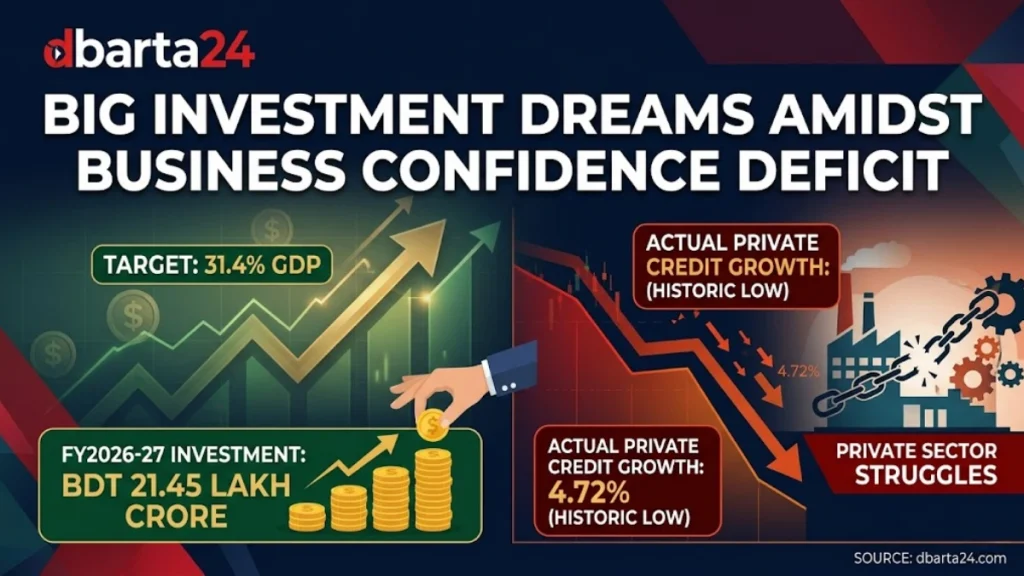
Muhammad Tareq , Dhaka – Despite high inflation, soaring bank loan interest rates, an ongoing dollar crisis, and a prolonged stagnation in capital deployment, the government is setting a massive investment target for the upcoming 2026-27 fiscal year.
According to Finance Ministry sources, the new budget plans to target an aggregate investment equivalent to 31.4% of the Gross Domestic Product (GDP). In monetary terms, this ambitious goal amounts to BDT 2,145,133 crore, calculated against an estimated total GDP size of BDT 68,31,633 crore.
The Investment Breakdown: Private vs. Public Sector
To hit this milestone, the government is heavily banking on the private sector, aiming to secure:
-
Private Sector Investment: 24.9% of GDP, which equates to roughly BDT 17,11,072 crore.
-
Public Sector Investment: 6.5% of GDP, translating to approximately BDT 4,44,056 crore.
Ministry officials stated that the government is prioritizing investment growth to stimulate employment and economic expansion. Special emphasis will be placed on infrastructure, logistics, agro-processing, IT, healthcare, renewable energy, and industrialization across designated economic zones. Furthermore, the government plans to extend tax incentives, policy assistance, and ease-of-doing-business reforms to attract foreign direct investment (FDI).
Economic Reality vs. High Ambitions
Despite the government’s optimism, prominent economists and business leaders warn that achieving such high targets will be incredibly difficult under current market conditions.
The primary prerequisite for a vibrant investment climate is policy stability and affordable credit. However, to curb persistent inflation, Bangladesh Bank has long maintained a tight contractionary monetary policy. This has driven up interest rates, making industrial loans highly expensive and causing private-sector credit growth to collapse.
According to central bank data, private credit growth reached only 6.40% in FY 2024-25 against a target of 9.8%. Consequently, the target for the ongoing FY 2025-26 was downscaled to 7.2% for December, but actual growth lagged at 6.10%. After stagnating at 6.03% through January and February, private credit growth plunged further to an all-time low of 4.72% in March.
Private Credit Growth Trajectory (FY25-FY26)
Target (FY25):       |||||||||||||||||||| 9.80%
Achieved (FY25):     ||||||||||||| 6.40%
Target (Dec FY26):   ||||||||||||||| 7.20%
Achieved (Dec FY26): |||||||||||| 6.10%
Achieved (Mar FY26): ||||||||| 4.72% (Historic Low)
What Experts and Business Leaders Say
Dr. Zahid Hussain, former Lead Economist at the World Bank’s Dhaka office, noted that while setting massive investment targets is a positive indicator of intent, actual execution hinges strictly on restoring macroeconomic stability:
“To sustain high economic growth, an effective investment rate of at least 30% of GDP is mandatory. However, achieving that in the current climate is a massive hurdle. Developing infrastructure alone isn’t enough anymore; rebuilding investor confidence is the ultimate challenge. Without policy predictability, financial sector stability, and rapid structural reforms, major capital will not flow in.”
Dhaka Chamber of Commerce and Industry (DCCI) President Taskeen Ahmed echoed similar concerns, adding:
“Merely setting a massive numerical target is not enough; a genuinely investor-friendly ecosystem is vital. High tax burdens, steep interest rates, policy uncertainties, and foreign exchange market volatility are actively draining business confidence.”
Due to these compounding factors, including fuel uncertainties and a severe dollar crunch, many local entrepreneurs are freezing expansion plans, focusing solely on keeping existing industrial units operational.
Silver Lining: A Surge in Foreign Investment
Despite the heavy domestic headwinds, foreign direct investment (FDI) has recorded a notable uptick. The latest central bank survey indicates that net FDI inflows jumped by 39.36% in 2025, climbing to $1.77 billion up from $1.27 billion in 2024.
Expressing optimism for the upcoming fiscal year, Finance Minister Amir Khosru Mahmud Chowdhury shared new developments at a recent public event:
“Major global fund managers and institutional investors are now showing immense interest in Bangladesh. World-renowned investment banks like JPMorgan Chase want to enter our market. We are actively planning to establish Bangladesh-centric investment funds in major financial hubs like Hong Kong and London, alongside launching highly lucrative domestic bonds.”