


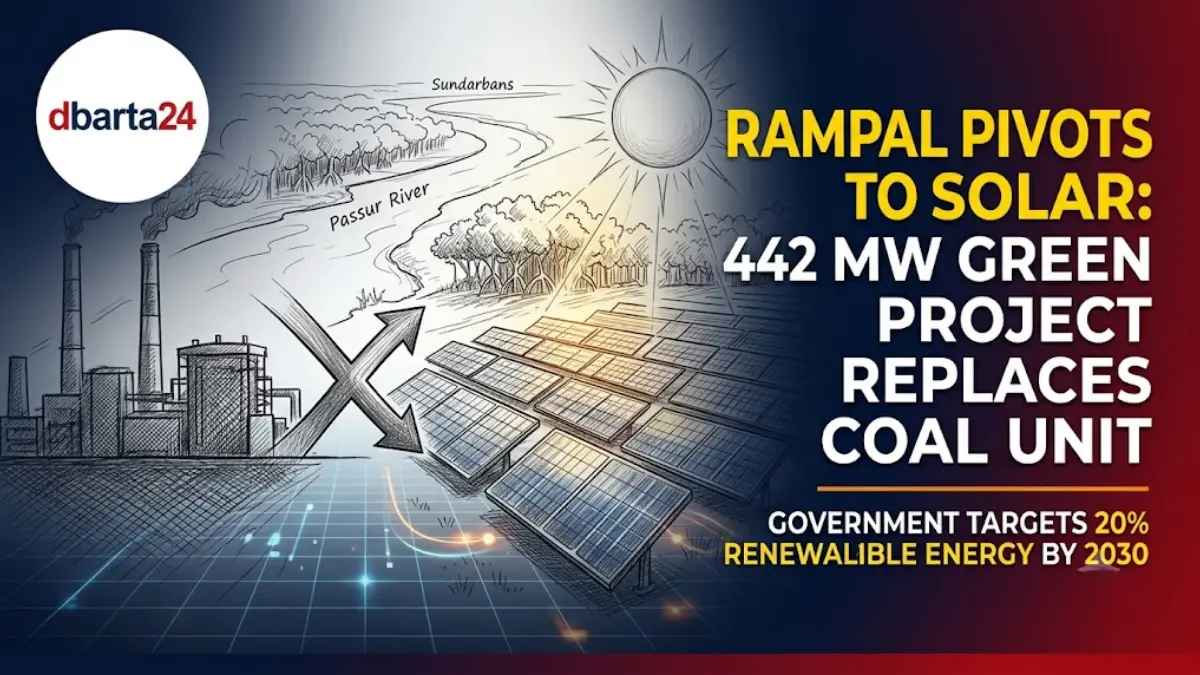
Labonnya Liza; Dbarta24 – In a major shift toward clean energy, the government of Bangladesh has decided to replace the planned second coal-fired unit of the controversial Rampal power complex with a 442 MW grid-connected solar power plant.
Estimated at BDT 2,502.39 crore (approximately $208 million), the project aims to reduce carbon emissions, decrease reliance on expensive imported fossil fuels, and support national targets for green energy expansion.
The initiative will be implemented by the Bangladesh Power Development Board (BPDB) on “Block-B” of the Rampal site—a 918.5-acre parcel of land that has remained unutilized since 2016.
Alignment with Renewable Energy Goals
The decision reflects a strategic effort to balance energy security with environmental commitments. Bangladesh currently derives less than 4% of its total electricity generation capacity from renewable sources.
The interim government aims to scale renewable power to 20% by 2030, with long-term ambitions targeting up to 30%.
“The project has been undertaken in line with the government’s development agenda,” said Md. Rezaul Karim, Chairman of the BPDB. “It will reduce dependency on imported coal, gas, and oil while expanding our green footprint.”
Under the revised Development Project Proposal (DPP), the solar array will occupy roughly 685 acres within Block-B. The remaining land will be designated for green belts, flood embankment protection, low-lying drainage, and water reservoir conservation.
The generated power will integrate into the national grid via a 230 kV transmission line through the existing substation operated by the Bangladesh-India Friendship Power Company Limited (BIFPCL).
Cost Revisions and Optimized Land Use
Following a Project Evaluation Committee (PEC) meeting chaired by the Planning Commission’s Industry and Energy Division, the project’s original cost estimate of BDT 2,845 crore was trimmed by over BDT 340 crore to BDT 2,502 crore. The project completion timeline was also shortened by eight months, setting a final deadline of June 2029.
Funding will be drawn from BPDB’s internal reserves (BDT 375.36 crore) and the Power Sector Development Fund (BDT 2,127 crore).
Capital expenditure accounts for nearly 97% of the total budget, with BDT 923.9 crore allocated for solar photovoltaic (PV) modules and BDT 735.26 crore for electrical infrastructure including inverters, transformers, substations, and switchgears.
Energy expert and BUET Professor Dr. M. Tamim praised the pivot away from coal. “Replacing the second coal unit with solar energy is a positive step that avoids further ecological damage,” Dr. Tamim noted. “Because primary land acquisition, embankment construction, and basic infrastructure were completed during Phase 1, the site is already primed. This drastically reduces execution time and capital expenditure.”
The Planning Commission has also recommended multi-purpose land usage on the site, suggesting canal restoration, systematic afforestation, and poultry farming alongside solar panel installations.
Planning Commission Demands Rigorous Environmental Checks
Despite the shift from coal to solar, the project’s proximity to the ecologically sensitive Sundarbans mangrove forest—a UNESCO World Heritage site—has drawn scrutiny from planners.
The Planning Commission highlighted that the project proposal currently lacks a detailed Environmental Impact Assessment (EIA) regarding toxic waste management (such as solar panel decommissioning), high salinity impacts, and disaster resilience against cyclones and tidal surges common to the Passur River basin.
“The project proposal was evaluated thoroughly, and overall costs were scaled down compared to traditional projects,” explained Mohammad Ashraful Islam, Joint Chief of the Industry and Energy Division. “However, strict adherence to international environmental standards and comprehensive risk assessments are mandatory before final approval.”
The project now awaits formal ratification by the Executive Committee of the National Economic Council (ECNEC).
Economic and Environmental Impact
Addressing the long-term potential of the green transition, Dr. Rashed Al Mahmud Titumir, Advisor to the Ministry of Finance and Planning, emphasized the dual economic benefit of clean energy infrastructure.
“Expanding our renewable capacity lowers overall state expenditure on fuel imports while unlocking fresh investments, long-term savings, and localized economic opportunities,” Titumir stated.
If approved by ECNEC, the Rampal solar installation will rank among the largest single-site photovoltaic developments in Bangladesh, marking a significant milestone in the country’s energy transition.