


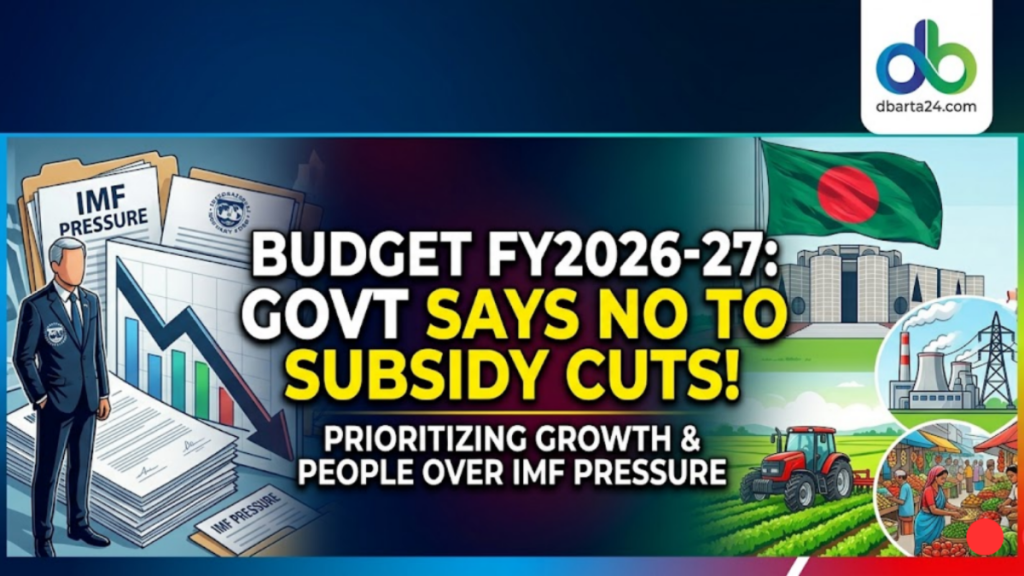
Economic Desk: Despite continuous pressure from the International Monetary Fund (IMF) to trim fiscal cushions, the government is set to increase its subsidy spending in the upcoming national budget.
Amid persistent inflationary pressures, volatile global energy markets, and escalating Middle East tensions, the scope to reduce financial cushions in four critical sectors—power, energy, food security, and agriculture—has effectively shrunk.
Unwilling to risk economic shocks, policymakers are prioritizing crisis management by expanding policy support.
Consequently, the primary estimate for subsidies, incentives, and cash loans in the upcoming FY2026-27 budget has been set at BDT 116,125 crore.
This marks a BDT 3,670 crore increase from the BDT 112,455 crore allocated in the revised budget of the current FY2025-26.
Power and Energy Sector Consumes Lion’s Share
The largest portion of this allocation will fund direct subsidies, initially projected at BDT 72,100 crore, up from BDT 68,200 crore in the current revised budget.
The power sector alone is slated to receive BDT 37,000 crore, maintaining parity with the previous year.
Additionally, BDT 6,500 crore is earmarked for gas imports, while fertilizer subsidies are projected at nearly BDT 27,000 crore.
Finance Division officials revealed that ongoing geopolitical tensions in the Middle East have forced a strategic rethink. Spikes in international fuel prices directly inflate domestic power generation costs.
An official from the Power Division explained that while the government could theoretically offset costs by raising electricity tariffs, doing so would drive up industrial production costs and trigger a fresh wave of inflation—a risk the government is determined to avoid.
Energy expert Dr. M. Shamsul Alam noted that cutting subsidies under current conditions is unrealistic, as a massive gap remains between production costs and consumer-level pricing.
Protecting Agriculture and Food Security
Analysts observe that the government is not yet in a position to let market forces dictate pricing completely. Hence, despite international pressure for structural reforms, state dependency on hefty subsidies remains unavoidable.
The food subsidy is projected at BDT 9,600 crore, compared to the current fiscal year’s revised allocation of BDT 10,214 crore.
An official from the Directorate General of Food stated that because Open Market Sales (OMS), TCB, and food-friendly programs run year-round, cutting expenditures here is impossible.
Meanwhile, agricultural incentives remain unchanged at BDT 17,000 crore, heavily driven by high fertilizer procurement costs. Agricultural economist Professor Mahbub Hossain warned that with international markets for fertilizer and fuel remaining highly volatile, failing to support farmers would put national food production at direct risk.
Boost for Remittance Incentives
The budget proposal also allocates BDT 32,025 crore for policy incentives. While export incentives (BDT 7,825 crore) and jute sector incentives (BDT 1,200 crore) remain unchanged, remittance incentives will be boosted from BDT 6,200 crore to BDT 7,000 crore.
Finance Ministry officials stated this move aims to stabilize foreign currency reserves and maintain a steady inflow of remittances.
Additionally, the government will allocate BDT 12,000 crore for cash loans as a block allocation for contingencies.
Dr. Zahid Hussain, former Lead Economist at the World Bank’s Dhaka office, concluded that Bangladesh is caught in a policy dilemma.
On one hand, it faces donor agency compliance conditions; on the other, it must juggle revenue constraints and social security obligations.
As a result, subsidies have become a permanent fiscal pressure from which escaping is proving difficult.