

















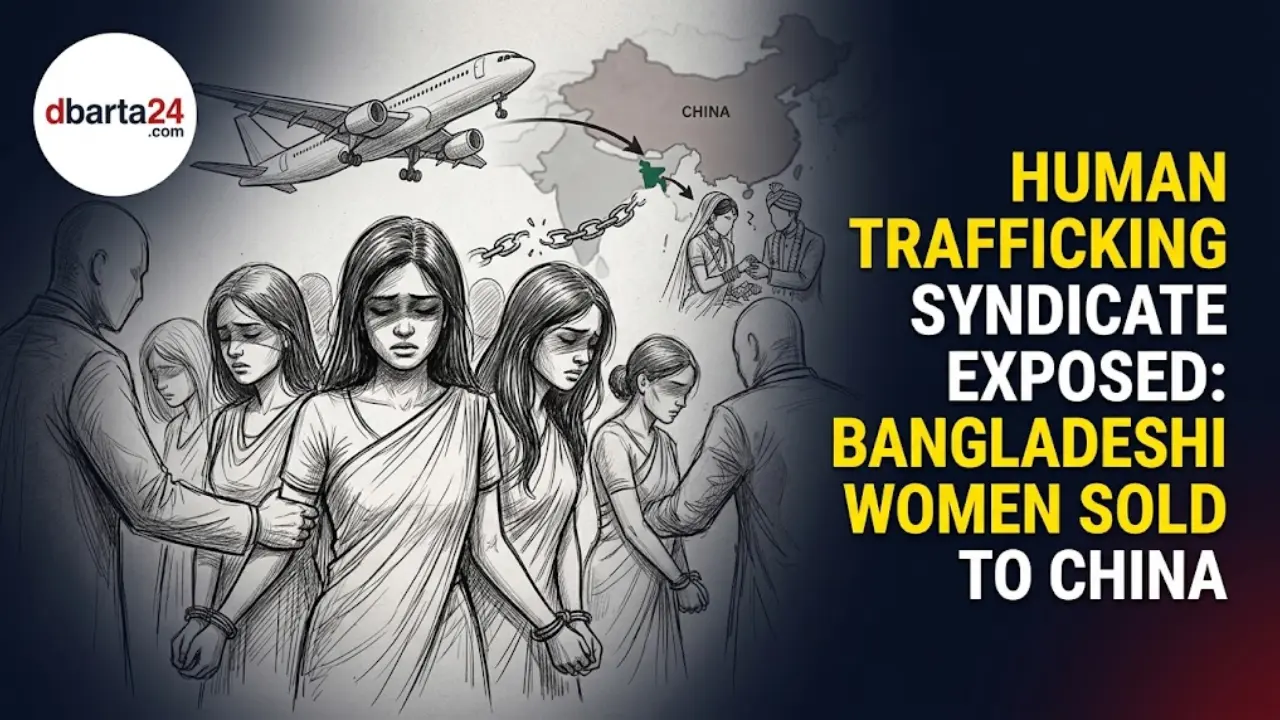
Fake Marriages, Real Slavery: Nationwide Syndicate Luring Bangladeshi Women Abroad Exposed
Khairul Alam; dbarta24 – An international human trafficking network operating across Bangladesh is luring young women and girls into foreign countries, including China and Cambodia, under the guise of fake marriages and lucrative job offers.
Investigations reveal that traffickers use registered marriage deeds as “legal passports” to bypass immigration authorities, subjecting victims to severe abuse, torture, and forced captivity upon arrival.
According to official data and law enforcement insights, at least 1,300 Bangladeshi women traveled to China as brides in 2025 alone. Investigators suspect that more than half of these cases involve human trafficking.
A Trapping Mechanism: From Staged Weddings to Captivity
The network operates through a structured system designed to evade law enforcement and embassy officials.
Local brokers target vulnerable and low-income families in remote rural areas, hill tracts, and urban centers, promising well-paying jobs or wealthy foreign husbands.
Once brought to secret safehouses in Dhaka, victims are coerced into compliance.
Traffickers frequently use blackmail—such as recording compromised videos after drugging the victims—to force them into marrying foreign nationals, predominantly Chinese citizens.
To make the arrangement appear legitimate, the syndicate organizes elaborate wedding ceremonies complete with traditional attire, photographs, and legal documentation.
These staged events serve as proof for visa applications at foreign embassies, allowing the perpetrators to move victims out of the country undetected.
Human Price Tags and Ongoing Abuse
Once abroad, the victims are stripped of their travel documents and held in confinement.
Price tags on these women range from 8 lakh to 20 lakh BDT ($6,500 to $16,500 USD), determined largely by age and appearance. The money is distributed among local and foreign members of the syndicate.
A victim from Khulna, who managed to escape captivity in Henan province with the help of local Chinese citizens and the anti-trafficking organization Justice and Care, recounted her ordeal:
“After reaching China, the abuse started immediately. I was locked inside a small room in Henan province. My alleged husband told me he had bought me for 20 lakh BDT.”
She further revealed that at least 50 Bangladeshi women remain trapped under similar conditions in and around Guangzhou city alone.
Law Enforcement Action and Key Operators
Law enforcement agencies, including the Criminal Investigation Department (CID), have stepped up crackdowns on the network following recent rescues from Cambodia and China.
Several key operatives, including local handlers, have been arrested.
Speaking on the scope of the operation, CID Additional Superintendent of Police Mostafizur Rahman stated:
“We recently held a meeting with the Chinese Embassy. They informed us that around 1,300 women traveled to China as brides in 2025. Based on the complaints we are receiving, we suspect at least half of them are victims of trafficking.”
Investigative sources indicate that the international operations are spearheaded by female ringleaders based in China, who direct a network of 30 to 35 active brokers across Bangladesh.
Authorities are continuing cross-border coordination to dismantle the syndicate, trace missing victims, and ensure the prosecution of key operatives managing the illegal network.