


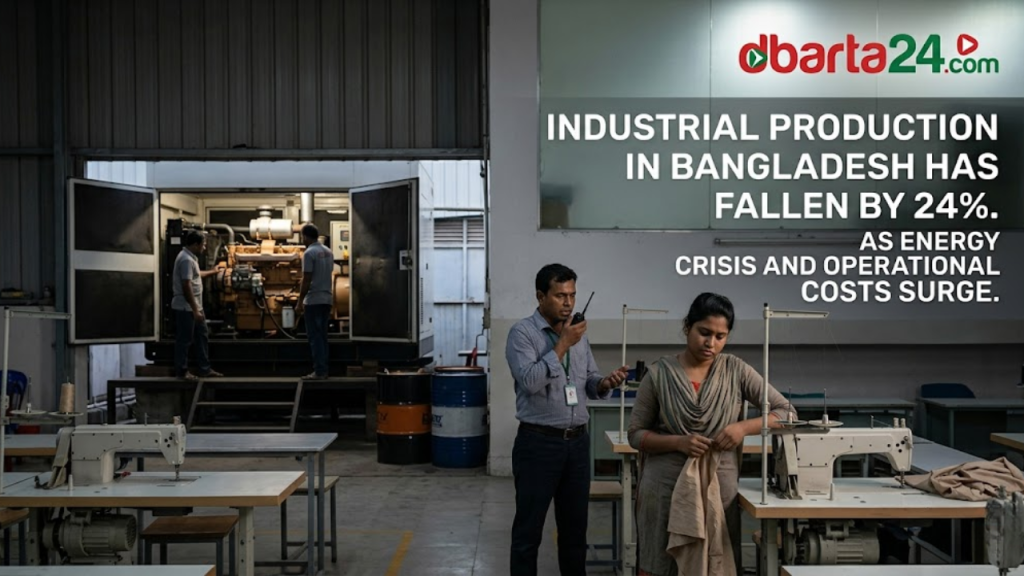
Business Desk: Bangladesh’s industrial sector is facing an unprecedented crisis as a persistent energy shortage and skyrocketing operational costs have forced a 24% decline in average production.
Over the last two months, major hubs including Chattogram, Savar, Gazipur, and Narayanganj have reported severe disruptions in garment, steel, cement, and pharmaceutical manufacturing.
A ground-level analysis reveals that while production has dropped by nearly a quarter, operational expenses have surged by over 30%.
The reliance on expensive diesel generators due to frequent load shedding, coupled with a 20-40% rise in transport costs, has pushed many factories to the brink of closure.
Regional Impact: Chattogram and Beyond
In Chattogram, the country’s commercial capital, 1,676 registered factories are struggling to survive. Steel giants like Abul Khair Steel and GPH Ispat have seen significant output drops.
Heavy industries are particularly vulnerable; a single power interruption requires nearly two hours to restart machinery, damaging equipment and reducing productivity.
In the garment hubs of Savar and Gazipur, daily production has fallen by 15-25%. Small textile and dyeing factories in Gazipur are facing three times the usual fuel costs, making their operations nearly unsustainable.
Meanwhile, in Khulna, the frozen fish and jute industries report a 25-30% decline in production, with cold storage facilities struggling to maintain temperatures during 8-10 hours of daily load shedding.
Government and Industry Response
State Minister for Power and Energy, Anindya Islam Amit, stated that “Fuel Cards” are being issued to BGMEA members to ensure priority access to diesel at pumps. He also urged factory owners to invest in solar panels to reduce grid dependency.
However, industry leaders remain worried. BGMEA President Mahmud Hasan Khan warned that the combined pressure of reduced capacity and the Trump administration’s additional tariffs on RMG exports poses a “red alert” for the economy.
If the energy supply does not stabilize soon, experts fear long-term impacts on national employment and the export-driven economy.