


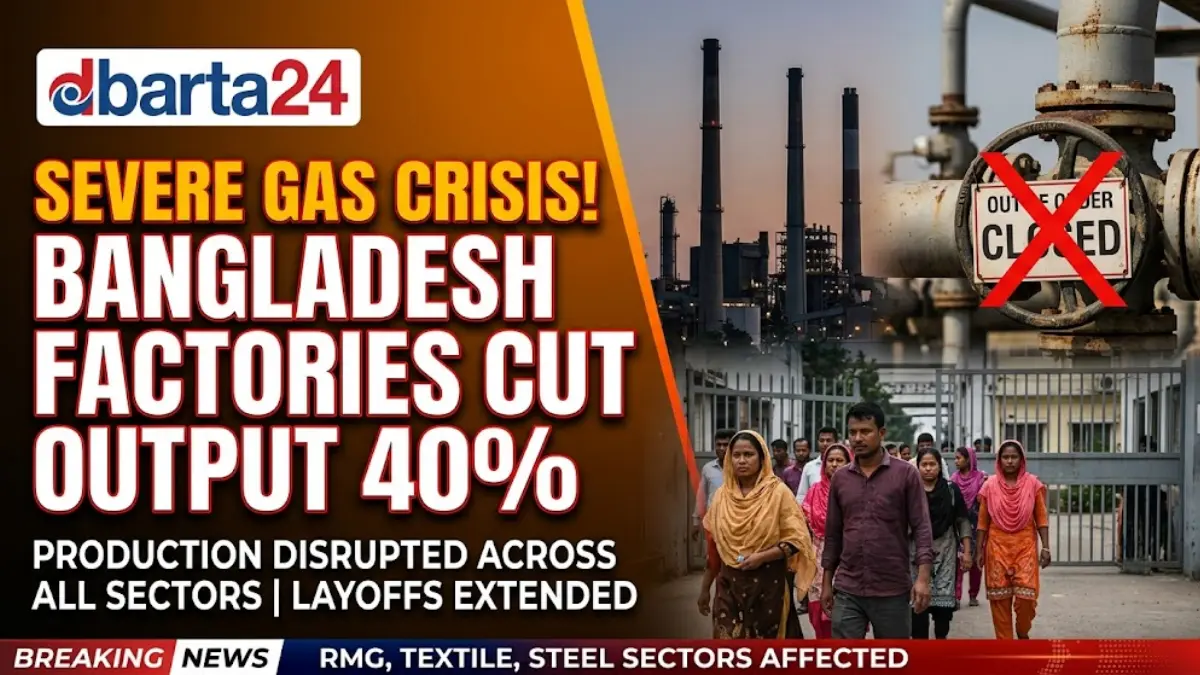
Saad_Sajid; Dbarta24 — A worsening gas crisis paired with persistent electricity load-shedding has dealt a severe blow to Bangladesh’s industrial sector over the past two weeks, forcing major manufacturing units to slash production by up to 40% and extend employee leave schedules.
The nationwide shortage—triggered primarily by an explosion at a Floating Storage and Regasification Unit (FSRU) in Maheshkhali—has severely disrupted supply chains across critical sectors, including ready-made garments (RMG), textiles, consumer goods, steel, glass, and ceramics.
Garment and Textile Sectors Under Severe Strain
The ready-made garment and textile industries, the backbone of the nation’s export economy, face heavy operational bottlenecks. At Gazipur’s Konabari industrial belt, Mitali Fashion’s dyeing section has been completely shut down for eight days due to low gas pressure, idling 18 out of its 30 garment sewing lines.
“It has become nearly impossible to maintain factory operations under these conditions,” said Abu Yousuf Abdullah, Chairman of Mitali Fashion. “We will fail to deliver export orders on schedule, which will likely force us to offer discounts to buyers.”
Similarly, industrial giant DBL Group has extended its operational shutdown in Gazipur by combining the August 5 public holiday with three additional days of factory leave due to the inability to run dyeing units.
“Dyeing factories simply cannot operate without gas,” stated M.A. Rahim, Vice Chairman of DBL Group. “We initially announced leave from August 5–7, but extended it by another day at the workers’ request, hoping gas supply will improve before we reopen.”
Mahmud Hasan Khan, President of the Bangladesh Garment Manufacturers and Exporters Association (BGMEA), highlighted that garment factories are currently functioning at only 60% to 70% capacity. He urged the government to prioritize industrial supply over private CNG vehicles and called for swift administrative intervention.
Heavy Industries Face Catastrophic Risks
The crisis poses an existential threat to process-heavy industries such as glass manufacturing. Continuous furnace operation is vital in glass production; if a furnace cools due to zero gas pressure, it sustains irreversible damage and must be completely rebuilt.
Amir Hossain, Managing Director of PHP Float Glass Industries in Chattogram, noted that gas pressure at their plant has dropped to a critical 75 PSI.
“If the pressure falls below this line, the furnace will gradually fail,” Hossain warned. “Rebuilding a ruined furnace requires an investment of nearly BDT 500 crore. Uninterrupted gas flow is essential to protect existing industrial assets.”
Steel producers and ceramic manufacturers are echoing similar alarms. In letters to utility providers, industry groups noted that gas pressure in industrial clusters—including Gazipur, Savar, Narayanganj, and Bhaluka—frequently drops to zero. Alternative fuels like furnace oil or diesel offer only temporary, cost-prohibitive relief.
Consumer Goods Production Slumps
Producers of daily necessities have not escaped the crunch. Kohinoor Chemical Company in Tejgaon reported a 20% decline in the production of soaps, detergents, and cosmetics.
“Soaring import costs for raw materials due to Middle East tensions, combined with domestic gas shortages, have hit us hard,” explained Golam Kibria Sarkar, Senior Vice President (Brand) at Kohinoor Chemical. “We cannot supply goods according to market demand, leading to heavy losses.”
Pran-RFL Group also reported that production at its Habiganj Industrial Park has plummeted to 40–45% of total capacity, severely affecting the output of plastic furniture, bakery items, and packaged food products.
Supply Bottlenecks and Policy Outlook
According to state energy authority Petrobangla, national gas supply dropped to 2,150 million cubic feet per day (mmcfd) against a national demand of 3,800 mmcfd after the Excelerate Energy FSRU terminal went offline. Authorities anticipate adding around 300 mmcfd back to the national grid once partial repairs are complete.
Addressing the structural crisis, Dr. Khondaker Golam Moazzem, Research Director at the Centre for Policy Dialogue (CPD), emphasized the urgent need to break away from LNG import over-reliance.
“Over-reliance on imported LNG without diversifying energy sources has worsened this crisis,” Dr. Moazzem noted. “While immediate terminal repairs are necessary, long-term stability requires aggressive domestic gas exploration, renewable energy adoption, and transitioning industries away from total gas dependency.”