


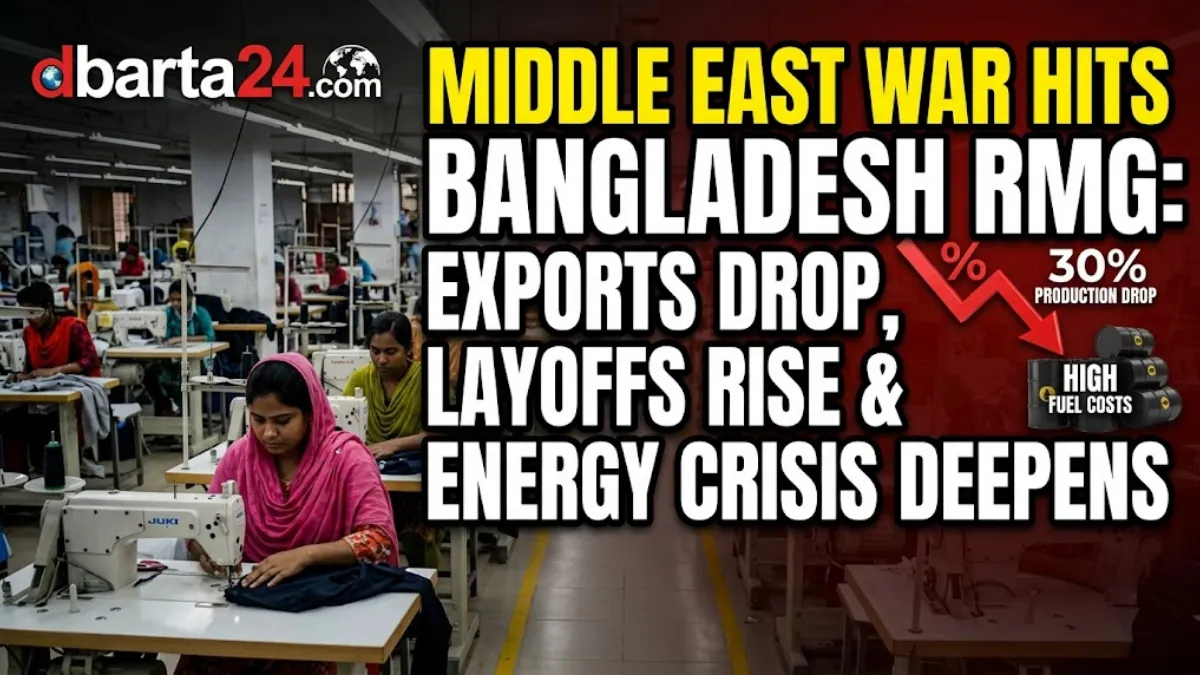
Muhammad Tareq , Dhaka — The escalating military conflict in the Middle East, involving the United States, Israel, and Iran, has sent shockwaves through Bangladesh’s industrial sector.
The ready-made garment (RMG) industry—the backbone of the country’s economy—is facing catastrophic pressure due to critical power shortages, soaring fuel prices, and dwindling global orders.
The operational crisis has already forced major manufacturers to downsize. On June 6, the Al-Muslim Group, one of the nation’s premier apparel exporters, laid off approximately 1,900 workers from its knitwear and denim factories, signaling deep-rooted distress in a sector already grappling with macroeconomic headwinds.
Severe energy instability across industrial hubs has worsened production capabilities.
In May, Dhaka and its surrounding manufacturing zones suffered an average of two hours of daily power outages, while the port city of Chattogram experienced devastating load-shedding lasting up to eight hours a day.
To maintain operations, factories have resorted to expensive diesel-run generators, dramatically inflating overhead costs.
“This industry is highly efficiency-dependent; if it takes 10 to 15 minutes just to start a generator, it can cause major financial losses,” explained Abil Bin Amin, a representative of the Ethical Trading Initiative, highlighting how even minor operational delays cascade into severe financial deficits.
Consequently, overall apparel production plummeted by roughly 30 percent between February and May 2026.
This domestic supply disruption, combined with shipping bottlenecks and weakening consumer demand in Western markets, has prompted international fashion brands to significantly scale back their purchase volumes.
“Since the onset of the war, purchase orders at my factory have dropped by nearly 20 percent,” stated Abdullah Hil Nakib, owner of a jacket manufacturing plant.
According to recent data from the Ministry of Commerce, May marked the tenth consecutive month of declining garment exports, registering an 8 percent year-on-year drop.
The consistent contraction underscores the vulnerabilities of the export-oriented economy to geopolitical disruptions.
In response to the deepening crisis, Bangladesh Bank announced a massive short-term stimulus package worth BDT 60,000 crore in May, primarily targeted at supporting the apparel sector.
However, the relief has faced skepticism from entrepreneurs due to its 7 percent interest rate, which many argue places an additional financial burden on businesses already operating on razor-thin margins.
Furthermore, manufacturers express deep concern that global apparel brands will refuse to adjust pricing to absorb rising production costs, mirroring the unfavorable commercial dynamics observed during the COVID-19 pandemic.
As geopolitical tensions show no signs of easing, Bangladesh’s RMG sector stands at a critical crossroads.
Navigating this multi-front crisis will require not only immediate government intervention in stabilizing energy supplies but also more favorable financial terms from local lenders and collaborative fair-pricing strategies from global buyers to ensure the industry’s long-term resilience.