


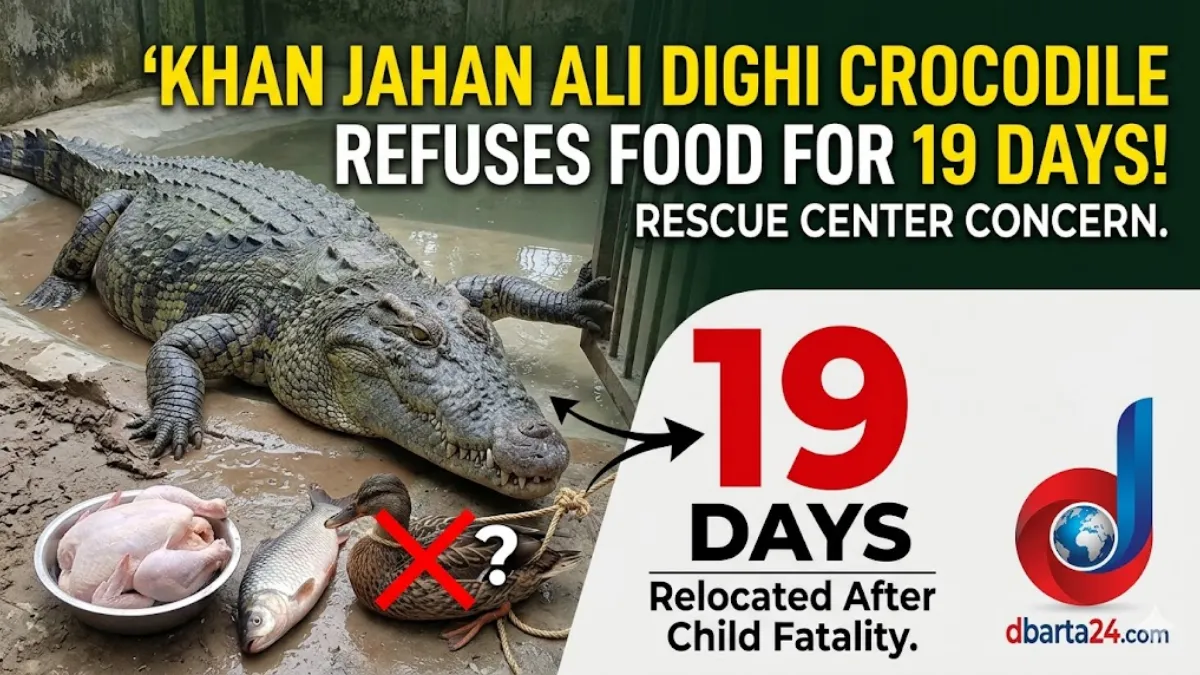
M K Alam from Khulna – A 45-year-old female freshwater crocodile, relocated from the historic Hazrat Khan Jahan Ali (Rh.) shrine dighi (pond) in Bagerhat, has refused food for 19 consecutive days since being moved to the Wildlife Rescue and Rehabilitation Center in Khulna.
Despite being offered fish, chicken, and even live ducks tied up as easy prey, the reptile has consistently rejected sustenance.
Forest Department officials, however, have assured that there is no immediate cause for concern regarding its physical health. As reptiles, crocodiles are physically adapted to survive prolonged periods without food, especially given this particular crocodile’s high body fat.
The decision to relocate the crocodile was made following a tragic incident on June 1, when the reptile dragged away and killed a seven-year-old child near the shrine pond.
Prompted by public safety concerns, the Bagerhat district administration requested intervention. On June 3, the Forest Department, with administrative assistance, successfully rescued the crocodile and brought it to the Khulna center, where it has since remained under close monitoring.
Nirmal Kumar Pal, Divisional Forest Officer (DFO) of the Wildlife Management and Nature Conservation Division in Khulna, stated that the crocodile will remain at the facility for at least another month.
Regarding its future, he explained that returning it to the shrine pond depends entirely on the shrine authorities’ capacity to guarantee a secure environment for both visitors and the animal.
Previously, the crocodile occasionally strayed into nearby human settlements, creating mutual safety hazards. If the shrine authorities fail to implement sufficient safety measures, the issue will be escalated to higher authorities for a final decision.
The Forest Department has ruled out releasing the animal into the Sundarbans, clarifying that as a freshwater species, it would not survive in the mangrove forest’s saline waters.
Officials observed that the crocodile is showing signs of restlessness and a desire for a larger habitat, often crawling out of the water to nudge the enclosure gates. Physically, the female crocodile is notably obese, measuring between 7 to 8 feet in length and weighing an estimated 400 to 500 kg.
Because of its weight, it tires easily after walking a few paces on land, though it remains highly agile in water. Even though its predatory instincts are intact—having caught and killed one of the chickens provided—it chose not to consume it.
The rehabilitation center maintains strict care protocols, including daily water changes and showering the crocodile with fresh water when it rests on land. No outside visitors are permitted near the enclosure to minimize stress.
The situation highlights ongoing conservation challenges for freshwater crocodiles in Bangladesh.
Although the International Union for Conservation of Nature (IUCN) officially declared the species extinct in the wild across Bangladesh in 2000, several freshwater crocodiles have been rescued from various river systems over the past five to seven years—signaling a critical need for structured conservation and rehabilitation strategies.