


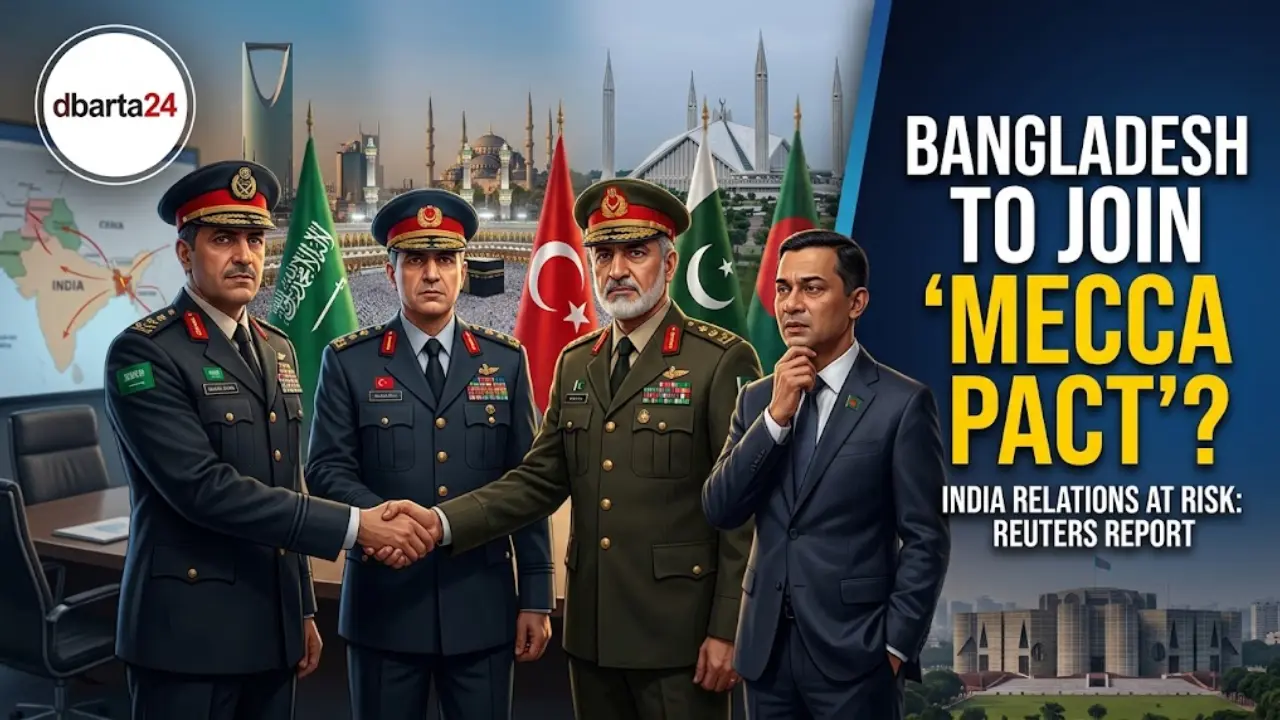
Diplomatic Correspondent; Dbarta24 — Bangladesh is actively evaluating an invitation to join the recently formed mutual defense alliance between Saudi Arabia, Turkey, and Pakistan—known as the ‘Mecca Pact.’
However, geopolitical analysts warn that aligning with the military pact could severely complicate Dhaka’s sensitive diplomatic relations with neighboring India and alter its long-standing non-aligned foreign policy.
The developments were highlighted in a Reuters report citing State Minister for Foreign Affairs Humayun Kabir.
The potential shift comes at a crucial diplomatic juncture for Bangladesh as it navigates complex regional dynamics and economic pressures.
Evaluating the Defense Invitation
Speaking to reporters on Monday, State Minister for Foreign Affairs Humayun Kabir confirmed that Dhaka is reviewing the prospect of joining the security block.
“If there is a security mechanism among Islamic countries in the Middle East, it is not unusual for us to consider participating there. This is being viewed positively,” said Humayun Kabir.
He further noted that regional leaders have extended invitations to Bangladeshi leadership, specifically inviting Prime Minister Tarique Rahman to participate in upcoming engagements.
A source within Bangladesh’s Ministry of Foreign Affairs, speaking on the condition of anonymity, corroborated that Saudi Arabia formally invited Dhaka to accede to the treaty, though the exact timeline of the invitation was not disclosed.
Inside the ‘Mecca Pact’
Signed earlier this month in the holy city of Mecca, the mutual defense treaty unites three prominent Sunni-majority nations: Saudi Arabia, Turkey, and nuclear-armed Pakistan.
Modeled after NATO’s collective defense principle, the agreement dictates that an armed attack against any individual member state will be considered an attack against all signatories.
The pact emerged amid escalating regional tensions triggered by Iranian missile strikes across the Middle East.
Turkey, which commands NATO’s second-largest army, indicated that the alliance remains open to expansion for interested nations.
While Bangladesh operates as a secular republic, over 90 percent of its population identifies as Sunni Muslim, creating cultural and diplomatic overlaps with the founding states.
Testing Bangladesh’s Traditional Neutrality
For decades, Bangladesh has adhered to a cautious diplomatic balance, avoiding formal military blocs to maintain robust trade and economic ties across competing geopolitical spheres.
Geopolitical analyst Kallol Kibria emphasized that formal membership in a military bloc could force Dhaka into uncomfortable diplomatic corners.
“These relationships will not break automatically. But once Bangladesh joins a military alliance, it will become far more difficult to avoid the question of whose side Bangladesh is on,” Kibria remarked.
Kibria warned that joining the pact could complicate Bangladesh’s relations not only with India, but also with major global partners including the United States, China, Russia, Japan, Iran, UAE, Qatar, Oman, and Kuwait.
The economic stakes are particularly high. Bangladesh relies heavily on ready-made garment exports to the European Union, the United Kingdom, and the United States, while foreign exchange reserves are heavily sustained by remittances sent by millions of Bangladeshi expatriate workers based in the Middle East.
Diplomatic Implications for India-Bangladesh Relations
Tensions between Dhaka and New Delhi are already heightened following the political upheaval of August 2024, which led to the ousted former Prime Minister Sheikh Hasina taking refuge in India.
Friction has persisted as Bangladesh formally seeks Hasina’s extradition and raises concerns over border push-in incidents by Indian border security forces.
Diplomatic experts observe that New Delhi is unlikely to welcome Bangladesh’s entry into a defense treaty that includes its long-time adversary, Pakistan.
As formal responses regarding extradition remain pending, joining the Mecca Pact presents a high-stakes decision for Bangladesh, forcing its leadership to weigh immediate strategic security interests against broader economic and geopolitical consequences.
Requests for official comments from the embassies of Saudi Arabia, Turkey, and Pakistan in Dhaka went unanswered at the time of reporting.