


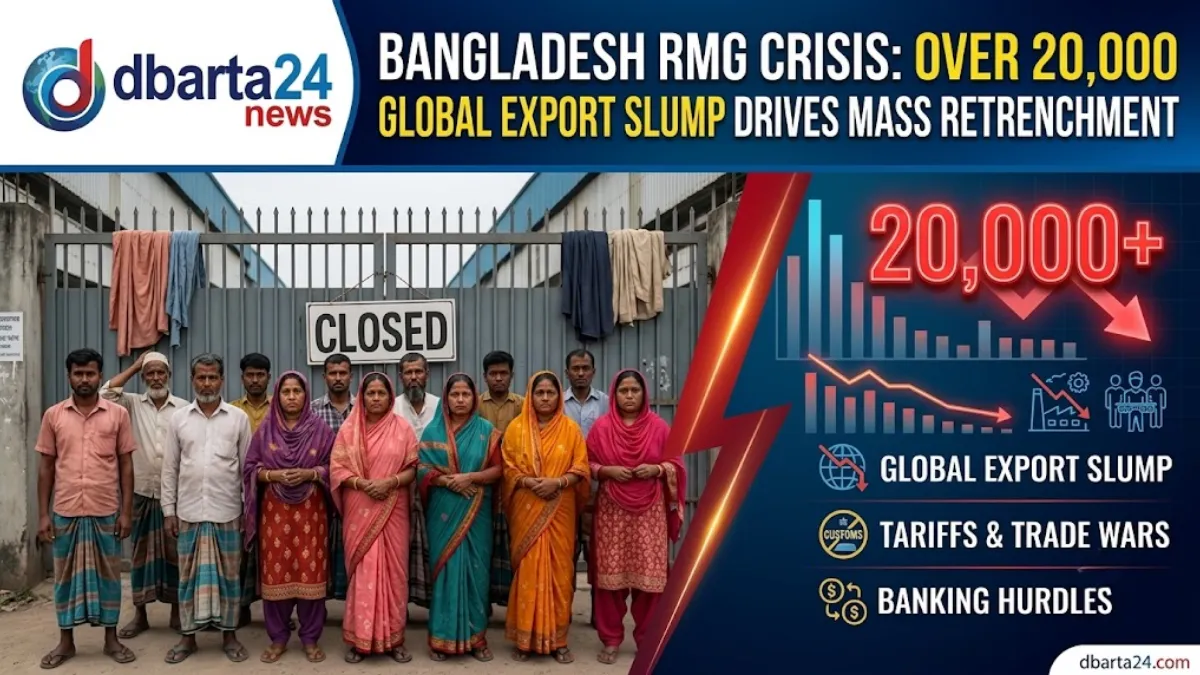
Sajahan Kabir from Gazipur — Bangladesh’s vital Readymade Garment (RMG) sector is facing severe headwinds as major industry bodies and industrial police data reveal that at least 20,000 workers were retrenched or lost their jobs in the first six months of the year.
Financial distress, dwindling global purchase orders, and strict banking regulations have forced numerous factories to either scale down or shut operations entirely.
The crisis hits hardest at the grassroots level, leaving thousands of workers unemployed. Prominent examples include the permanent closure of Unique Washing & Dyeing and Unique Designers in Gazipur on June 16, which abruptly terminated 1,800 workers who are still waiting for their outstanding wages, allowances, and statutory compensations.
Escalating Factory Closures and Mass Layoffs
A joint analysis of data from the Industrial Police, the Bangladesh Garment Manufacturers and Exporters Association (BGMEA), and the Bangladesh Knitwear Manufacturers and Exporters Association (BKMEA) paints a grim picture.
According to the Industrial Police, 79 factories across eight industrial zones terminated 7,784 workers in the first five months of the year alone. The Savar-Ashulia belt saw the highest impact with 35 affected factories, followed closely by Gazipur with 33.
The retrenchment wave peaked in March and May, coinciding with the Eid-ul-Fitr and Eid-ul-Azha festival periods. Shockingly, immediately following the Eid-ul-Azha holidays, the Al-Muslim Group in Savar terminated 1,868 workers from three of its production units overnight, pasting the notice on the factory walls.
BGMEA data tracks an even wider impact, noting that 19,188 workers were dismissed across 80 member factories within the first half of the year, leading to the permanent closure of 27 establishments.
Geopolitical Headwinds and Banking Bottlenecks
Industry insiders attribute this slump to a perfect storm of global economic shifts and local financial hurdles. Apparel exporters point out that retaliatory tariffs imposed by US President Donald Trump over the last year have deal a heavy blow to Bangladeshi shipments targeting America.
The situation deteriorated further due to intensified market competition in Europe and escalating geopolitical tensions sparked by conflicts involving Iran. Export Promotion Bureau (EPB) figures confirm a 3.41% drop in RMG exports for the July-May window compared to the previous fiscal year.
Closer to home, factory owners complain about a credit crunch. BGMEA President Mahmud Hasan Khan and BKMEA President Mohammad Hatem both noted that severe institutional roadblocks, paired with aggressive bank policies, have starved factories of essential financial assistance, accelerating closures.
Union Crackdowns Alleged Amid Rising Tension
While owners emphasize financial insolvency, labor union leaders voice darker concerns. They argue that export drops are marginal and allege that the sudden spike in terminations is actually a retaliatory measure against workers trying to form trade unions.
A labor amendment ordinance implemented last November lowered the minimum requirement to form a trade union to just 20 consenting employees, down from the previous threshold of 20% of the total factory workforce.
Salahuddin Shapon, former secretary-general of the IndustriALL Bangladesh Council, noted that a section of factory owners is responding aggressively to this legal ease, firing workers under various pretexts when they attempt to organize.
Additionally, Babul Akhter, general secretary of the Bangladesh Garments and Industrial Workers Federation, demanded a rigorous government probe, suggesting that some owners might even be shutting operational units deceptively to claim government incentive packages.
With further global uncertainty on the horizon, stakeholders agree that unless internal banking support stabilizes and global apparel demand rebounds, the employment crisis in the country’s manufacturing heartlands will continue to intensify.