


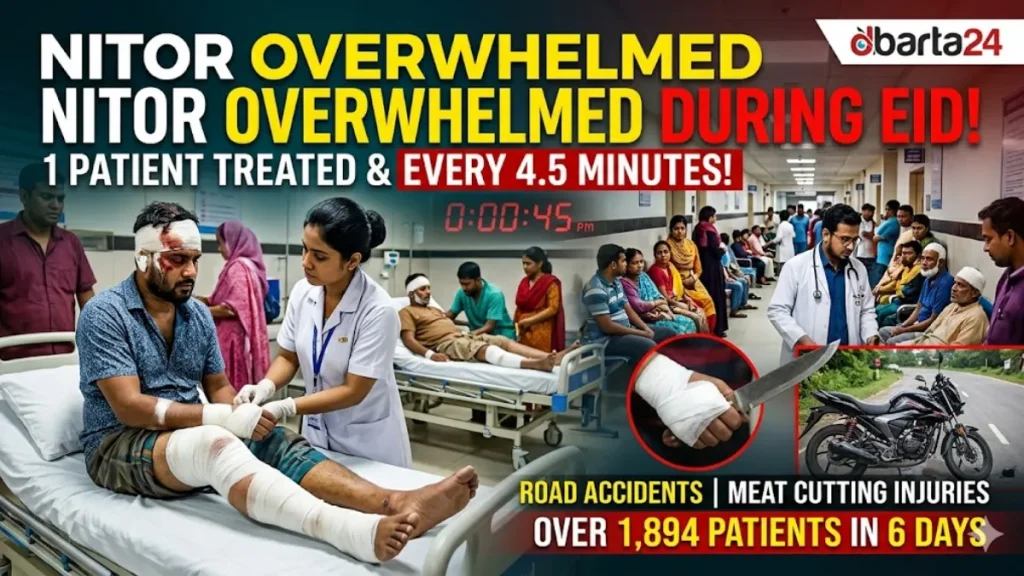
Muyabia Labony ; Dhaka – The National Institute of Traumatology and Orthopaedic Rehabilitation (NITOR), popularly known as the Pongu Hospital, faced an overwhelming rush of patients during the holy Eid-ul-Azha holidays.
Over a span of six days before and after Eid, the emergency department of the hospital provided treatment to 1,894 patients. According to calculations, this averages out to one patient arriving at the hospital every 4.5 minutes.
Hospital authorities revealed that the vast majority of these patients were victims of various accidents. Among them, 239 people (12.61% of the total) were injured while sacrificing animals and cutting meat. Additionally, 195 patients (10.29%) were treated for injuries sustained in motorcycle accidents.
Visiting the emergency department of NITOR on Sunday afternoon, a heavy influx of road accident victims was observed. Some arrived with broken limbs from motorcycle crashes, while others sustained severe injuries trying to control sacrificial animals. Deep gashes, fractured bones, and surgical marks were common sights among the patients admitted across different wards.
Insights from Hospital Authorities
Speaking on the situation, NITOR Director Professor Dr. Md. Abul Kenan stated:
“Over the six days surrounding Eid, 1,894 patients received emergency treatment due to various accidents. Out of them, 697 patients are currently admitted. While injuries related to animal sacrifice and meat cutting happen every year during Eid, most were given primary care and discharged. Those with severe injuries required admission and immediate surgery.”
Hospital sources confirmed that over 400 minor and major surgeries were performed during this holiday period. To cope with the immense pressure, 24 doctors were deployed per shift, with additional doctors joining as needed.
Amidst the festive joy of Eid elsewhere, the wards of NITOR presented a grim reality. Some had lost their mobility in tragic accidents, some were waiting for surgery, while others spent their festival days in the hospital corridors, praying for the recovery of their loved ones.
Dreams Shattered by Accidents
Bappi Hossain, a 20-year-old resident of Kalia Upazila in Narail, went out for a motorcycle ride with friends the day after Eid. Shortly into the ride, a head-on collision with an autorickshaw left him severely injured.
His left leg was fractured, and he sustained injuries to his head, hands, and abdomen. After receiving primary treatment at a local hospital, he was rushed to NITOR in Dhaka.
While Bappi groaned in pain in the casualty block, his anxious mother, Runa Akter, sat beside him.
“The doctors said his leg condition is critical. Decisions will be made after a few more tests. I am deeply worried about my son’s future,” she said.
Long queues were spotted in front of the emergency room, X-ray department, ticket counter, and doctors’ chambers. A significant number of patients had traveled from districts outside Dhaka. Dr. Alamgir Shikdar, an emergency medical officer, noted that accident cases invariably spike during Eid holidays, and this year was no exception.
Expert Opinions on Safety
Commenting on the surge in accidents, urban and transport expert Professor Adil Muhammad Khan pointed out that massive crowds travel within a short timeframe during Eid. However, preventing accidents is nearly impossible without ensuring a safe transport framework.
He emphasized:
“We cannot solely blame individual carelessness. Highway management, adequate public transport, strict regulation of unfit vehicles, and proper law enforcement must be addressed with equal urgency to minimize such tragedies.”