


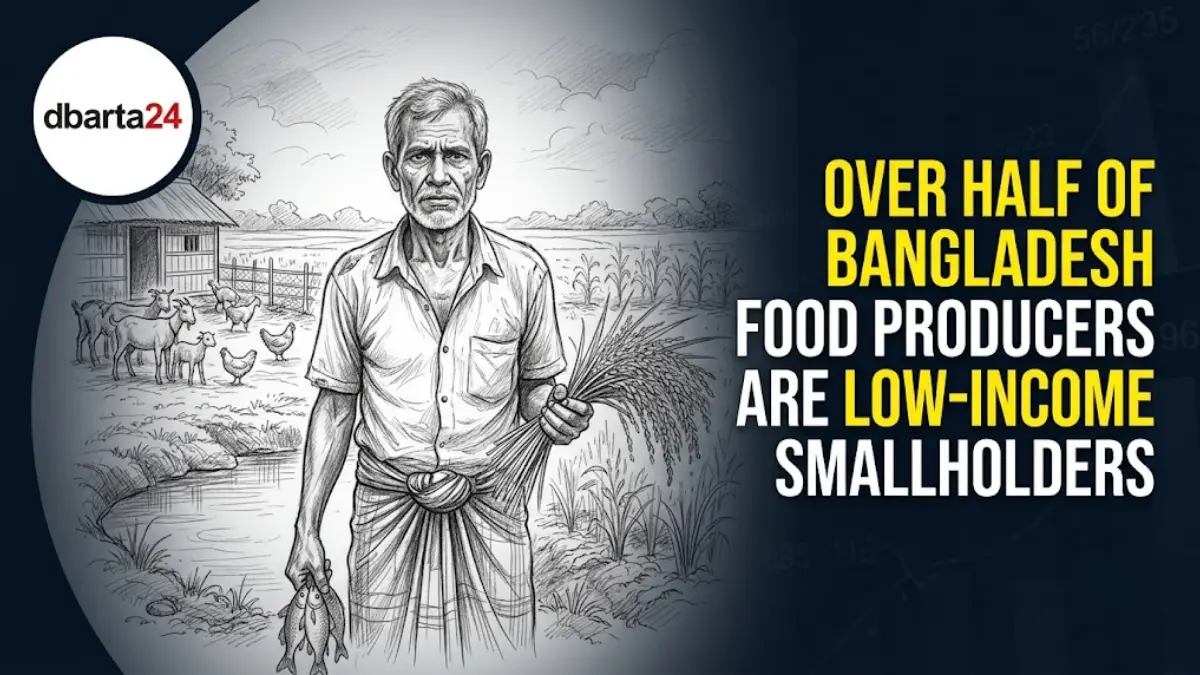
Khairul Alam; Dbarta24— Smallholder farmers account for more than half of Bangladesh’s total food producers, yet their annual net income remains nearly four times lower than that of large-scale producers, according to a landmark national survey released by the Bangladesh Bureau of Statistics (BBS).
The final report of the “Income and Productivity Survey of Small-Scale Food Producers 2025” reveals that 53.65% of food producers across the country operate on a small scale.
Despite anchoring national food security, these smallholders earn an average annual net income of just Tk 33,639, compared to Tk 1,29,956 earned by large-scale agricultural producers.
The survey, designed to benchmark progress toward the UN Sustainable Development Goals (SDG 2.3.1 and 2.3.2), covered 12,879 households across five major sub-sectors in eight divisions.
Agricultural Producer Disparity at a Glance:
├── Share of Total Food Producers : 53.65% (Smallholders)
├── Women-Led Small Households   : 10.70%
├── Annual Net Income            : Tk 33,639 (Small) vs. Tk 1,29,956 (Large)
└── Daily Labor Productivity     : Tk 1,494 (Small) vs. Tk 2,301 (Large)
Income and Productivity Gaps
The BBS report underscores significant income disparity and labor productivity gaps driven by shortages of capital and modern technology.
At the national level, average labor productivity per work day stands at Tk 1,868. However, smallholders generate only Tk 1,494 per day compared to Tk 2,301 produced by large-scale operators.
Regionally, Chattogram holds the highest concentration of smallholders at 59.81%, closely followed by Rangpur at 59.29%. Sylhet boasts the highest concentration of large-scale producers.
When analyzing earnings by division:
-
Rajshahi recorded the highest annual income for smallholders (Tk 44,707) and the highest daily productivity (Tk 2,093).
-
Sylhet recorded the lowest annual average income for smallholders at Tk 24,636.
-
Mymensingh logged the lowest daily productivity rate at Tk 1,135.
Livestock and Fisheries Drive Earnings
Livestock farming emerged as the primary income engine for smallholders, contributing 84.5% of their total earnings. Small producers earn an average of Tk 70,432 annually from livestock.
Fish farming generated the second highest return for smallholders at Tk 52,434 per year, followed by forestry (Tk 31,119), temporary crops (Tk 23,157), and permanent crops (Tk 19,068).
In terms of daily labor productivity across sectors, fish farming leads by a wide margin, generating Tk 11,382 per labor day. Intriguingly, smallholders outperformed large producers in daily productivity within permanent crops (Tk 6,530) and forestry (Tk 5,390).
Expert Insights and Policy Recommendations
Highlighting the importance of the baseline study, Project Director Muhammad Rafiqul Islam stated:
“This survey provides a crucial baseline for assessing agricultural progress toward SDG targets. By offering reliable national data on productivity and smallholder income, it will play a vital role in policy design, planning, and research.”
However, agriculture experts emphasize that policy intervention is urgently needed to address input costs and market exploitation. Agriculturist Dr. Md. Mizanur Rahman noted that while small farmers drive SDG contributions, middleman networks reap most of the profits:
“Small farmers contribute immensely to SDG goals, but they are not receiving equitable rewards. Wholesalers and middlemen profit while input costs for fertilizer and diesel continue to rise. The government must bridge this gap, ensure subsidies directly reach smallholders, provide low-interest credit, and curb the dominance of middlemen.”
Echoing these concerns, former Agriculture Secretary Anwar Farooq pointed out that crop farmers (growing rice, potatoes, and jute) earn even lower incomes than the average figure suggests, urging targeted government action to address sector-specific vulnerabilities.
The BBS findings highlight an urgent policy challenge: while smallholders remain the backbone of Bangladesh’s domestic food supply, low capital access and market inequities keep their earnings near subsistence levels.
Achieving SDG 2.3 by 2030 will require structural reforms, direct financial incentives, and streamlined market access to ensure small farmers benefit from the value they generate.