


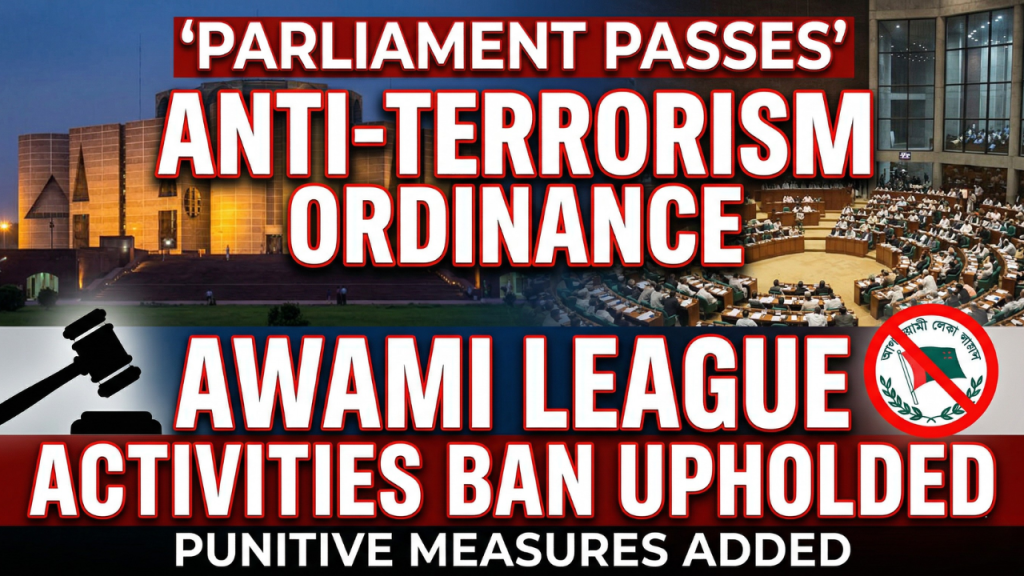
Staff Correspondent, DHAKA – The National Parliament on Wednesday passed the amended Anti-Terrorism Ordinance, formally upholding the ban on all activities of the Bangladesh Awami League and its affiliate organizations. The ordinance, originally promulgated by the interim government, was transformed into law with new provisions for punitive measures.
The move comes after the BNP-led government decided to codify the interim government’s executive order into a permanent statute. While the BNP had previously stated it did not support banning political parties via executive orders, the party moved to legalize the ban and introduce specific punishments for violations after forming the government.
Legal Deadlines and Special Committee Review
On March 13, the first day of the 13th Parliament, 133 ordinances issued by the interim government were placed before the house. A 14-member special committee was formed to scrutinize these laws. According to Article 93 of the Constitution, any ordinance not passed by Parliament within 30 days—by April 12 in this case—would have lost its legal validity.
Last Thursday, the special committee recommended:
-
98 ordinances be passed without changes.
-
15 ordinances be passed with amendments.
-
16 ordinances be deferred.
-
4 ordinances be repealed.
Tighter Restrictions and Punishments
The “Anti-Terrorism Ordinance” issued on May 11, 2025, was among the 15 amended bills. This law amended Sections 18 and 20 of the Anti-Terrorism Act 2009, which was used last year to ban the Awami League, its affiliates, and the student wing, Chhatra League.
Under the newly passed law, the restrictions on the Awami League remain comprehensive. Per Section 20, the party is prohibited from:
-
Holding processions, meetings, or rallies.
-
Operating party offices.
-
Accessing frozen bank accounts.
-
Displaying posters or banners.
-
Issuing press releases or holding press conferences.
-
Publishing content in mainstream or social media.
New Penalties for Violations
A significant addition to the law is the introduction of criminal liability. The original ordinance lacked specific sentencing guidelines for “prohibited entities” that continued to operate. Following recommendations from the Ministry of Home Affairs, the law now mandates:
“Any prohibited entity or individual found conducting activities in violation of the ban shall face imprisonment ranging from 4 to 14 years.”
Previously, while activities were banned, there were no clear legal consequences for defying the order. This legislative update closes that loophole, making it significantly harder for the Awami League to conduct any form of political banking or public engagement.
Background of the Ban
The ban originated following intense protests in May last year near the Chief Adviser’s residence, led by NCP leaders and joined by Jamat-e-Islami, Gono Odhikar Parishad, and other parties. On May 11, 2025, the interim government amended the law to allow the government to ban entities involved in “terrorist activities” via executive order, citing the pending trials at the International Crimes Tribunal as a primary justification.