


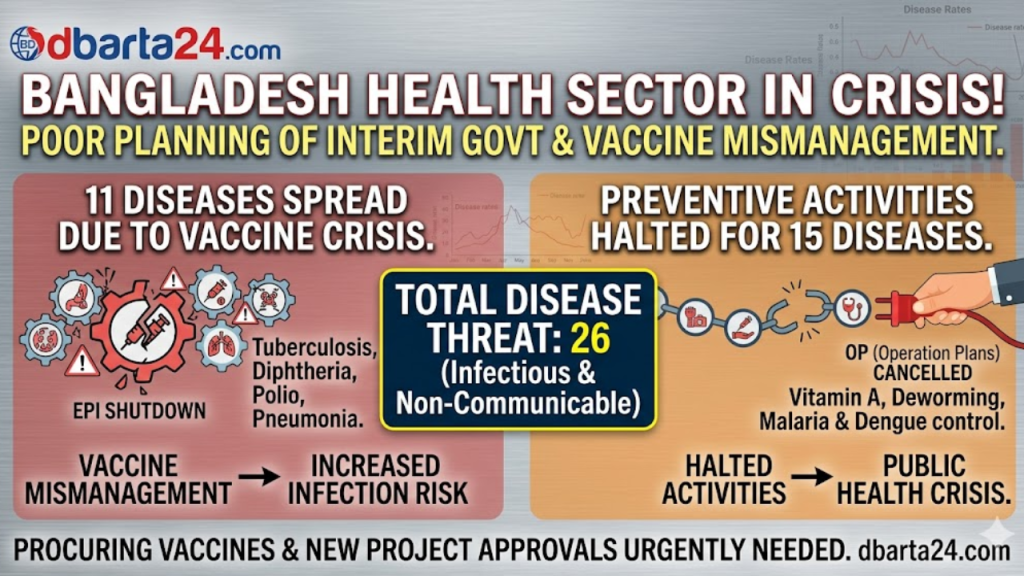
Labonnya Liza; Dhaka – The healthcare sector in Bangladesh has faced a severe setback as prevention and control programs for 26 diseases have stumbled.
Due to procurement complexities during the previous interim government, a shortage of vaccines for 11 diseases emerged, disrupting national immunization efforts. Furthermore, preventive activities for 15 other diseases have been suspended, creating a high-risk public health crisis.
Suspension of Operation Plans (OP)
Since 1998, disease prevention has been managed under the Sector Program through various Operation Plans (OP). The 4th Health, Population and Nutrition Sector Program (HPNSP) ended in June 2024. Although the 5th phase was set to begin in July 2024, the interim government abruptly halted several OPs in March last year. This move has paralyzed 38 programs, including infrastructure development, research, and supply of medical equipment.
Impact on Immunization (EPI)
The Expanded Programme on Immunization (EPI), which protects children from 11 life-threatening diseases (including Tuberculosis, Diphtheria, Polio, and Pneumonia), faced a major hit. A decision to bypass UNICEF in vaccine procurement led to bureaucratic delays and a massive supply gap until December last year. Consequently, many children missed their scheduled doses, increasing the risk of infections.
26 Diseases at Risk
Public health experts, including Professor Dr. Be-Nazir Ahmed, warn that the lack of coordination has put the country at risk of outbreaks for diseases such as:
-
Infectious: Dengue, Malaria, Chikungunya, TB, Polio, Measles, and Rubella.
-
Non-communicable: Diabetes, Hypertension, and Mental Health issues.
-
Nutritional: Night blindness (due to stopped Vitamin A campaigns) and Anemia in pregnant women.
Crisis in Specialized Care
The crisis extends to 35 Child Development Centers (autism care) and HIV detection programs, where kit shortages are hindering diagnosis. Additionally, the livelihoods of over 25,000 health workers remain uncertain as their salaries have been halted for two years following the suspension of the Operation Plans.
Experts urge the current government to prioritize the approval of new Development Project Proposals (DPP) to prevent a total collapse of the national health system.
Understanding the National Immunization Schedule (EPI)
To understand which vaccines were affected, here is the standard schedule for children in Bangladesh:
| Vaccine Name | Diseases Protected Against |
| BCG | Tuberculosis (TB) |
| Penta (Pentavalent) | Diphtheria, Pertussis, Tetanus, Hepatitis B, HIB |
| PCV | Pneumonia |
| OPV & IPV | Polio |
| MR | Measles & Rubella |
| TCV | Typhoid |