


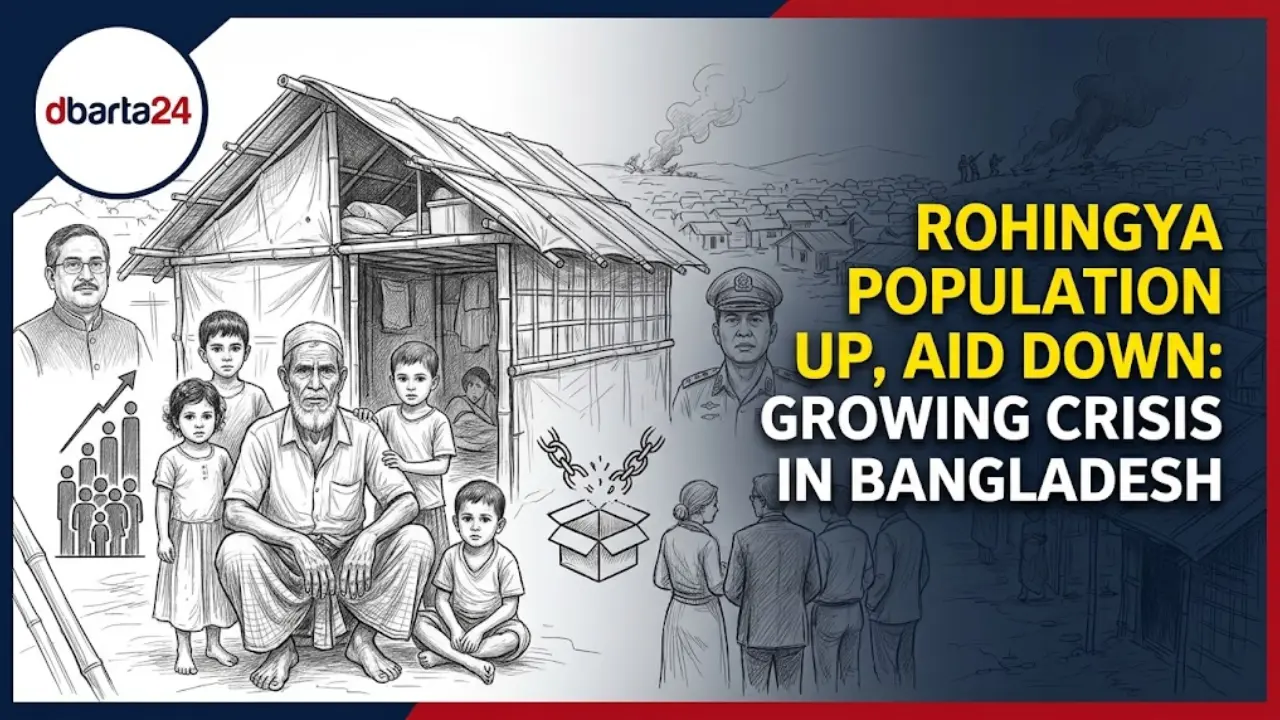
Shamchul Islam; Dbarta24,COX’S BAZAR — Inside the Leda Refugee Camp, located 17 kilometers from Teknaf, Muhammad Gura Mia and Jahida Begum share a cramped shelter made of bamboo, wooden poles, and tarpaulin with 12 family members.
When Gura Mia fled his home in Sin Di Praing, Bhuthedaung, Myanmar, in the 1990s, he arrived in Bangladesh with only his wife. Over the decades, his family size has grown sixfold, but his living space has remained unchanged.
To accommodate the growth, he built a makeshift loft using bamboo and wood—a visual testament to the severe housing constraints gripping the refugee settlements.
Gura Mia’s story reflects a widespread reality across Leda Camp and 32 other settlements in Cox’s Bazar.
As families expand within static boundaries, residents resort to building upward, partitioning single rooms, or sending older children elsewhere.
Nine years after the massive influx of August 2017, the official number of registered Rohingya refugees across these camps has reached 1.3 million, with over 36,500 individuals belonging to more than 7,500 families residing in Leda Camp alone.
+-----------------------------------------------------------------------+
|                    ROHINGYA CAMP STATISTICAL OVERVIEW                  |
+-----------------------------------------------------------------------+
| Total Registered Refugees (2026)      | ~1.3 Million                  |
| Annual Births in Camps                | ~30,000 per year              |
| Children Born in Camps (Last 8 Years) | ~270,000                      |
| Recent Influx (Dec 2024 – May 2026)   | 152,029 newly registered      |
| Awaiting Entry at the Border          | Estimated 25,000 to 30,000    |
+-----------------------------------------------------------------------+
Dwindling Aid Meets Demographic Expansion
While the camp population continues to expand due to natural birth rates and ongoing influxes from Myanmar’s volatile Rakhine State, international funding is declining.
For 2026, the United Nations and its partner agencies requested $710.5 million to address the humanitarian needs of both the Rohingya refugees and host communities.
This figure represents a 26% decrease compared to the previous year’s appeal. UN officials note that these requested funds represent the bare minimum required to maintain life-saving operations, including essential shelter repairs, regular maintenance, and structural safety management handled by UNHCR.
Bangladesh’s Relief and Repatriation Commissioner (RRRC), Mohammad Mijanur Rahman, highlighted that the funding shortfall threatens to worsen the existing humanitarian situation, reiterating that a permanent solution remains impossible without initiating repatriation.
In response to the evolving situation, the Bangladesh government established a national coordination framework in 2026 aimed at enhancing camp administration, law enforcement, and repatriation management.
Persistent Obstacles to Repatriation
Efforts to begin returning refugees to Myanmar face significant political roadblocks. The Ministry of Foreign Affairs of Myanmar issued a statement reiterating its stance referring to the displaced population as “Bengalis” and asserting that only individuals whose residence in Rakhine State can be verified will be considered for return.
Rohingya refugees inside the camps view these conditions as stall tactics designed to evade genuine repatriation and finalize their displacement.
Simultaneously, active conflict and instability in Rakhine State continue to force additional refugees across the border into Bangladesh.
Rezaul Karim, a recently arrived refugee, described fleeing to Bangladesh after members of the Arakan Army detained and tortured his uncle.
Between December 2024 and May 2026, authorities registered 152,029 newly arrived Rohingya refugees. Officials estimate that an additional 25,000 to 30,000 individuals remain gathered near the border, waiting for an opportunity to cross.
Security and Geopolitical Dynamics
The combination of dense living conditions and economic stress has created security challenges within the camps.
Local authorities report incidents of internal clashes, homicides, weapons trafficking, narcotics trade, extortion, and human trafficking, largely driven by rival armed groups vying for control.
Evaluating the geopolitical landscape, security analyst Major (Retd.) M. Emdadul Islam noted that international diplomatic pressure on Myanmar remains insufficient.
He observed that key regional players—namely China, India, and Russia—hold significant influence over the repatriation process due to their geopolitical interests in the region.
He added that the long-term resolution will depend heavily on international coordination and the policy stance adopted by the BNP-led government in Bangladesh.