


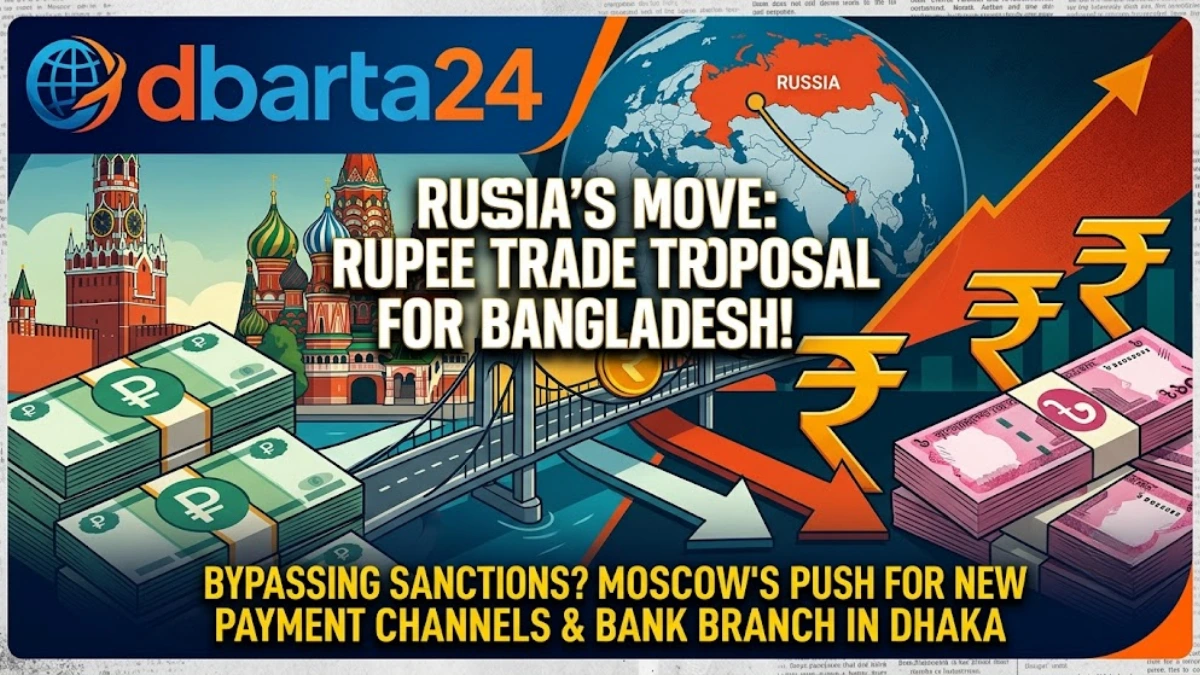
Md. Tareq; Dbarta24— In a bid to bypass international financial constraints triggered by US sanctions, Russia has proposed using the Indian Rupee (INR) to settle bilateral trade payments with Bangladesh.
Moscow has also renewed calls to build a dedicated independent payment infrastructure and permit a Russian bank to open a branch in Dhaka.
Russian officials believe these measures will overcome current banking bottlenecks, inject momentum into bilateral trade, and resolve long-standing payment deadlocks over mega-projects.
Navigating Sanctions and Rooppur Loan Repayment
Following the outbreak of the Russia-Ukraine war, major Russian financial institutions were cut off from global banking networks like SWIFT due to US-led sanctions. This severely disrupted traditional financial channels between Dhaka and Moscow.
The primary driver behind Moscow’s latest push is the stalled loan repayment for the Rooppur Nuclear Power Plant project. Bangladesh has been unable to remit loan installments directly to Russia due to sanction risks.
An earlier proposal to settle the debt in Chinese Yuan fell through after commercial banks in both Bangladesh and China hesitated over potential secondary sanction risks.
Currently, Bangladesh deposits loan installments into a special account in Russia’s name at Sonali Bank as an interim measure.
However, these funds remain frozen locally, as Moscow declined a Bangladeshi proposal to reinvest the accumulated money inside the country.
Leveraging Existing Indian Rupee Trade Frameworks
Moscow’s proposal builds on existing economic mechanisms in the region. Russia and India currently conduct a portion of their bilateral trade using the Indian Rupee.
Simultaneously, Bangladesh already engages in limited bilateral trade with India settled in Rupees alongside the US Dollar.
Russia aims to capitalize on Dhaka’s familiarity with Rupee transactions to establish a workable, low-risk financial conduit.
“The proposed mechanisms are aimed at overcoming financial barriers caused by sanctions, ensuring smooth bilateral trade, and reviving economic cooperation,” noted sources from Bangladesh’s Economic Relations Division (ERD).
Upcoming Intergovernmental Commission Meeting
Detailed negotiations on the Rupee settlement, dedicated financial channels, and the Russian bank branch proposal are scheduled for the upcoming meeting of the Bangladesh-Russia Intergovernmental Commission on Trade, Economic, Scientific, and Technical Cooperation, expected to take place in September or October 2026.
The ERD is currently holding preparatory sessions to solidify Bangladesh’s standing and finalize the agenda ahead of the high-level summit.
Beyond banking, Russia plans to introduce several initiatives during the talks, including:
-
Establishing a Russia-Bangladesh Business Council.
-
Creating an accredited registry of reliable Bangladeshi garment exporters.
-
Strengthening cooperation between Small and Medium Enterprises (SMEs).
-
Assisting in the establishment of Special Economic Zones (SEZs) in Bangladesh.
Trade Deficits and Commodity Supplies
Russia remains a critical source of essential commodities for Bangladesh, primarily wheat and fertilizers. To further deepen trade ties, Moscow recently offered to supply approximately 280,000 tonnes of urea fertilizer to Bangladesh at a discount of $10 per tonne below international market prices.
The offer was discussed during a meeting between Russian Charge d’Affaires Vyacheslav Sentyurin and Bangladesh Trade Minister Khandoker Abdul Muktadir. Russia has also expressed interest in supplying sunflower oil, chickpeas, yellow peas, and lentils.
Conversely, Bangladeshi exports to Russia have taken a major hit. Prior to the war, annual exports exceeded $500 million.
According to Export Promotion Bureau (EPB) data, Bangladesh exported only $245 million worth of goods to Russia during the July–May period of the current fiscal year, largely due to payment uncertainties.
Bangladesh’s Strategic Priorities
For the upcoming commission meeting, Dhaka plans to prioritize technology transfer alongside enhanced cooperation in:
-
Renewable energy, power generation, and overall energy security.
-
Digital economy, e-commerce, and innovation.
-
Agriculture, food security, and agro-processing industries.
-
Technical education, logistics, and regional connectivity.
As traditional financial channels remain locked under geopolitical tensions, Russia’s push for an alternative currency setup highlights the urgency both nations face in stabilizing their economic relationship.
The upcoming Intergovernmental Commission meeting will be pivotal in determining whether Bangladesh adopts the Rupee mechanism to keep vital development projects and trade flows moving forward.