


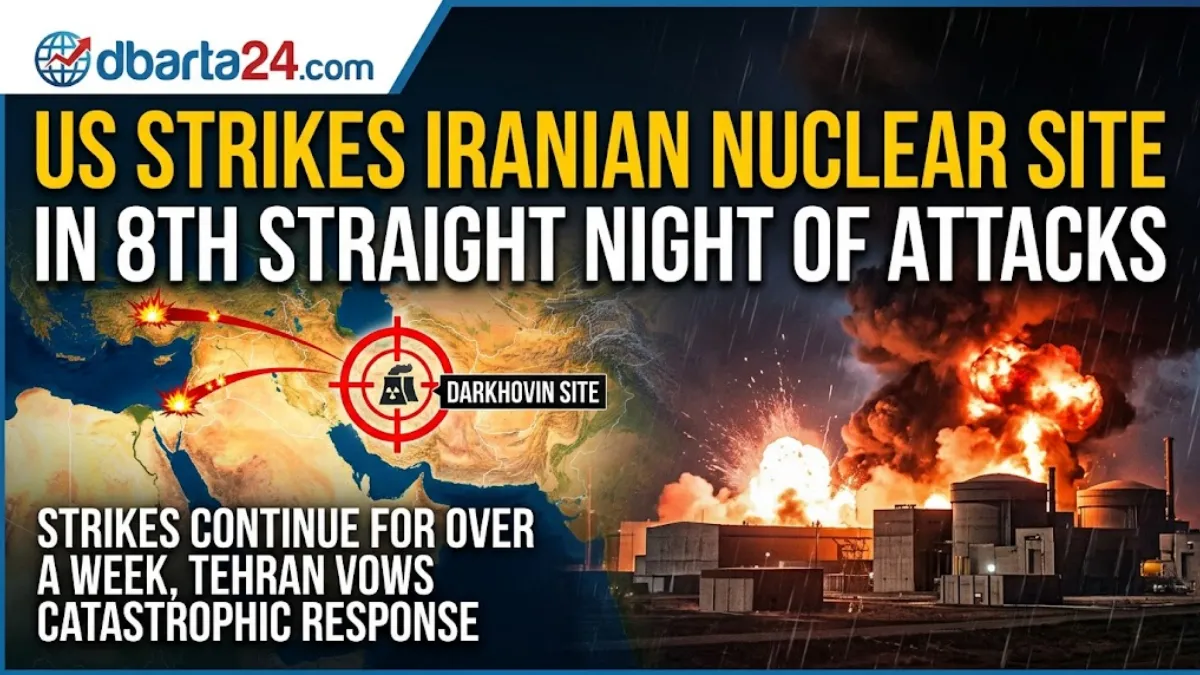
International Desk — Tensions in the Middle East reached a dangerous flashpoint as United States forces carried out airstrikes against targets in Iran for an eighth consecutive night, hitting multiple military positions and an under-construction nuclear power plant.
Tehran swiftly retaliated by targeting US military installations in Kuwait and warned Washington to prepare for a “catastrophic response.”
Nuclear Site Hit Amid Escalating Raids
According to Iranian authorities, Saturday night’s barrage included a direct strike on an under-construction nuclear power plant in the Darkhovin region of southwestern Iran. Additional strikes were reported near Sirik in the south and Shadegan along the Iraqi border.
The International Atomic Energy Agency (IAEA) confirmed that construction at the Darkhovin site was still in its early stages and stated it is investigating the strike. Meanwhile, the Atomic Energy Organization of Iran (AEOI) condemned the attack as an act of “terrorism” and a blatant violation of international law.
US Central Command (CENTCOM) stated the operation aimed to degrade Iran’s military capabilities near the Strait of Hormuz and hold the Islamic Revolutionary Guard Corps (IRGC) accountable for previous attacks on American troops in Jordan.
US President Donald Trump reiterated Washington’s stance, emphasizing that the primary objective remains preventing Iran from developing nuclear weapons capacity.
Diplomatic Accord Suspended
In response to the escalating violence, Iranian Deputy Foreign Minister Kazem Gharibabadi announced the suspension of a Memorandum of Understanding (MoU) signed with the US on June 17, citing American violations of the agreement’s terms. President Trump dismissed Tehran’s decision, stating it made “no difference” to him.
The collapse of diplomatic understanding has also fueled maritime friction in the Strait of Hormuz. Iranian forces issued warnings to several vessels on Sunday, alleging they were navigating “unsafe” routes designed to bypass Iranian maritime rules toward the Jordanian coast. Two ships retreated after the warning, while two others reportedly encountered accidents.
Tehran Retaliates Across the Gulf
Tehran claimed responsibility for striking US military assets at Kuwait’s Al-Adiri Camp and Ali Al-Salem Air Base. Kuwaiti officials reported that a desalination plant sustained damage for a second straight day. In Jordan, air defense sirens sounded as the military claimed to have intercepted several incoming Iranian drones.
Major General Ali Abdollahi, commander of Iran’s Khatam al-Anbiya Central Headquarters, pledged a severe counteroffensive: “If the United States continues its strikes, our response will be even harsher and catastrophic.” Iranian Parliamentary Speaker Mohammad Bagher Ghalibaf called for national unity in the face of foreign aggression.
Regional Ripple Effects
As regional instability deepens, Israeli officials confirmed preparations to receive additional military aerial refueling tankers from the US, despite Israel abstaining from direct strikes on Iran since an April 8 ceasefire.
Analyzing the situation, Ross Harrison, a senior fellow at the Middle East Institute, noted to Al Jazeera that military actions are effective only when aligned with strategic political goals.
He warned that persistent US bombardments might inadvertently unite the Iranian populace, ultimately complicating Washington’s long-term objectives.