


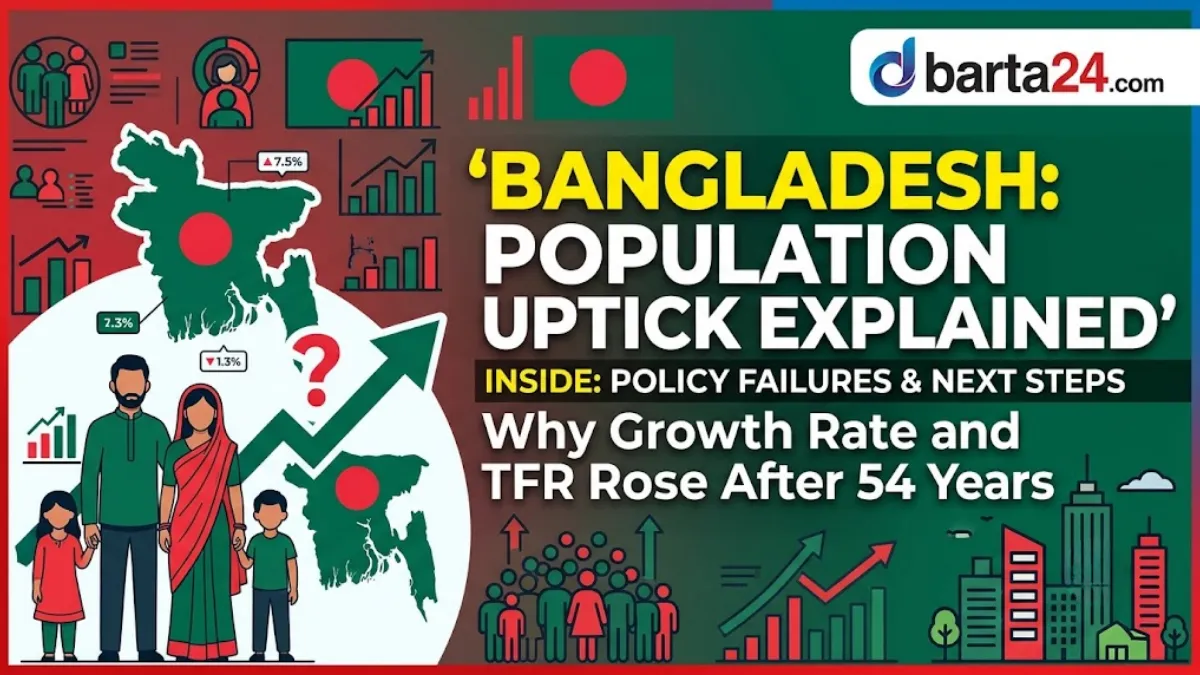
Khairul Alam ; Dbarta24 Explainer — For the first time since independence in 1971, Bangladesh is witnessing an unexpected rebound in its population growth rate.
According to official data from the Bangladesh Bureau of Statistics (BBS), the country’s population growth rate crept up by 0.01% in 2025 compared to the previous year.
Concurrently, the Total Fertility Rate (TFR) rose from 2.3 to 2.4 births per woman between 2024 and 2025.
While a fractional increase might seem minor on paper, demographers and policy analysts view it as a major red flag for the world’s ninth most densely populated nation—a country currently cramming an average of 1,366 people into every square kilometer.
Here is a breakdown of how the nation reached this inflection point, why current urbanization strategies are failing, and what needs to happen to reverse the trend.
The Historical Context: From Top Priority to Policy Stagnation
Bangladesh’s early success in population control was once hailed as a global public health triumph.
-
1973 First Five-Year Plan: Population control was declared a top national priority, kickstarting decades of aggressive field-level outreach and subsidization.
-
2000–2001 Shift: Field operations under the Directorate General of Family Planning (DFP) began scaling down, partially attributed to conservative political shifts within coalition governments.
-
2011–2024 Plateau: The annual growth rate stabilized at 1.12%. Experts warned that even stagnation was dangerous given the country’s limited land mass, but major interventions remained stalled.
-
2025 Uptick: Following years of neglect, official metrics recorded a rise to 1.13%, pushing the issue from a chronic concern into a pressing public policy crisis.
Urban Pressure and Infrastructure Strain
The failure to manage demographic expansion directly impacts Bangladesh’s primary urban center, Dhaka.
Mega-projects aiming to fix traffic congestion, expand water supply, improve sanitation, and provide affordable housing routinely fall short of demand.
The core driver is a fundamental gap in urban planning data: internal migration from rural districts to the capital is outpacing official projection models.
Rural areas continue to suffer from a lack of employment opportunities, institutional infrastructure, and basic services, forcing thousands daily to seek livelihoods in the capital.
When baseline population assumptions are flawed, newly built infrastructure becomes overburdened almost immediately upon completion.
Policy Gaps and Supply Chain Shortages
Recent reporting highlights severe operational bottlenecks within the health sector that have contributed directly to the surge:
-
Critical Staffing Shortages: Roughly 27% of the 54,000 sanctioned positions under the Directorate General of Family Planning (DFP) remain vacant. Field-level outreach has reached a standstill in many sub-districts.
-
Contraceptive Supply Crises: Except for two hill tract districts (Rangamati and Bandarban), non-availability or severe shortages of basic birth control commodities have been reported nationwide.
-
Omission from Strategic Plans: The 2025 National Population Policy framework and the National Family Planning Strategy (2025–2030) conspicuously omitted explicit numerical targets for reducing the Total Fertility Rate (TFR)—a departure from every previous national health framework.
“In the Health Reform Commission report prepared under the interim administration, there are no guidelines or recommendations for addressing the population problem.”
— Abu Taher Khan, Columnist and Public Policy Analyst
Furthermore, administrative attempts to merge the DFP into broader general health services—similar to past restructuring attempts involving measles vaccination procurement—have drawn criticism from public health experts who argue that family planning requires a dedicated, autonomous institutional focus.
Key Recommendations for Recovery
To prevent demographic growth from eroding economic development, policy experts emphasize six immediate steps for the government:
-
Update Strategic Targets: Revise the National Family Planning Strategy to establish an explicit target of reducing TFR to 2.0 by 2030.
-
Restore Institutional Autonomy: Preserve and empower the Directorate General of Family Planning (DFP) as a distinct, fully functional entity.
-
Fill Vacancies: Execute transparent, merit-based hiring to fill all 27% of vacant DFP posts by December 2026.
-
Fix Procurement: Ensure the immediate procurement and equitable nationwide distribution of essential contraceptive supplies following standard procurement protocols.
-
Reallocate Budgetary Resources: Adjust the national health budget to ensure dedicated funding streams for demographic control initiatives.
-
Reactivate Fieldwork: Re-train field workers and provide necessary logistical and travel allowances to resume door-to-door community outreach.
Looking Ahead
Sustainable economic growth cannot rely solely on high-profile infrastructure projects or political rhetoric.
With finite land and resources, unchecked population growth poses a direct threat to long-term national planning.
Elevating quality education and bringing the annual population growth rate below 1.0% by 2030 remain essential prerequisites for Bangladesh’s future development path.