


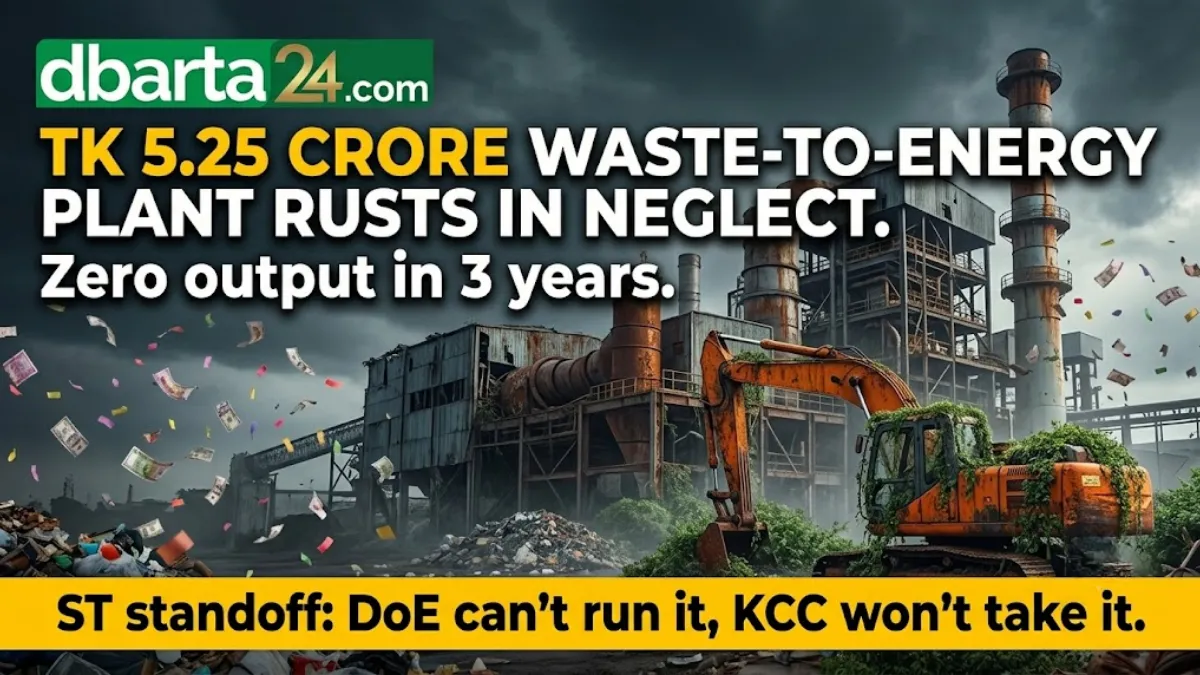
Khulna Bureau — A waste-to-energy and compost plant built by the Department of Environment (DoE) in Khulna city’s Mathabhanga area with a hefty budget of Tk 5.25 crore has been rotting away for three long years.
Funded by the Climate Change Trust Fund, construction wrapped up on June 15, 2023. Yet, far from producing fuel oil or organic fertilizer, the plant has failed to spin its wheels for even a single day.
The facility is now caught in a bureaucratic deadlock, with the local municipality refusing to take over a white elephant that has already fallen victim to rust, neglect, and theft.
A Vision Left to Rot
Initiated under the “3R Pilot Initiative Implementation (Phase-1)” project, the venture aimed to reduce greenhouse gases by curbing, reusing, and recycling urban waste. Ground was broken on July 3, 2022, across two acres of land in Mathabhanga, under Batiaghata upazila. The plant was designed to process daily urban refuse into:
-
20 tons of compost fertilizer.
-
500 liters of fuel oil extracted from plastic waste.
A total of Tk 4.40 crore out of the fund was explicitly spent on constructing administrative blocks, boundary walls, production chambers, and purchasing heavy machinery, including an excavator. All payments were promptly cleared to the contractor. However, once the deadline passed in June 2023, the real troubles began.
Faulty Equipment and Missing Specifications
When the DoE sent a letter requesting the Khulna City Corporation (KCC) to assume ownership of the site, KCC engineers conducted a thorough inspection. What they discovered was alarming: the critical machinery required to synthesize fuel oil lacked standard technical specifications.
There was no viable method to verify the quality or operational capacity of the provided equipment. Furthermore, the general construction standard was deemed highly unsatisfactory.
KCC formally declared that it would only take charge if the DoE-appointed firm, Sebak Agrovest, successfully operated the plant for a trial period of six months. The DoE failed to deliver on this condition. Fearing severe operational liability for a broken factory, KCC engineers backed off.
A physical inspection on June 25 revealed a apocalyptic scene: the entire complex is completely swallowed by dense overgrowth and wild bushes.
The heavy machinery, including the costly excavator, is heavily rusted. Crucial infrastructure elements, including electrical wiring, have already been pilfered by local thieves.
The Blame Game and Bureaucratic Standby
Despite the clear evidence of failure, efforts have intensified behind the scenes to push KCC into taking over the inactive facility as-is, backed by instructions from the Ministry of Local Government.
“If we accept a closed factory whose machinery cannot even be evaluated, who will take responsibility when things go wrong later? That is why we took our time. A committee has now been formed to review the matter.”
— Mashiuzzaman Khan, Chief Engineer of KCC.
Meanwhile, the current KCC Administrator, Nazrul Islam Monju, has drawn a hard line in the sand. “We will not accept an inactive plant. They must activate it and demonstrate its performance before handing it over to us,” Monju asserted.
Defending the project, Masud Iqbal Md. Shamim, the DoE Project Director, claimed that the pilot initiative was undertaken upon the direct request of the former KCC Mayor and insisted that similar plants in other districts are running smoothly. He maintained that they had demonstrated its operation at one point.
As the DoE scrambles to propose launching the compost wing first while consulting its central bureau in Dhaka regarding the faulty plastic-to-fuel machinery, the multi-million taka eco-plant remains an expensive monument to planning failure.