


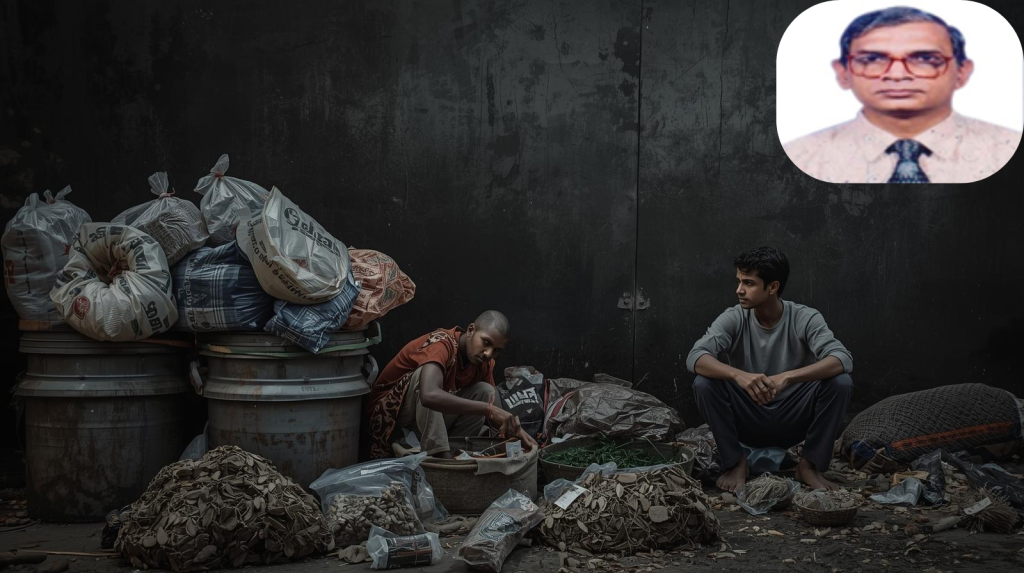
Life depends on food. Food tops the list of basic human needs because it is the essence of life itself. Yet, it is astonishing that despite abundant global food production, millions still suffer from hunger every day. The world currently produces enough food to feed 1.5 times its total population. Nevertheless, around 783 million people remain hungry, and roughly one-third of the global population faces food insecurity.
The root cause of this disparity is not a lack of production but waste, mismanagement, and unequal distribution. Approximately one-fifth of all food produced worldwide is wasted — equivalent to one billion meals a day. This waste costs nearly one trillion dollars annually. Along with money, vast amounts of land, water, labor, and energy are squandered — as is the moral conscience of humanity. Food waste contributes about 10 percent of global greenhouse gas emissions.
During its G20 presidency, Brazil proposed forming a Global Alliance Against Hunger and Poverty, which already includes 200 members — 103 countries and 97 partner organizations and foundations. This alliance aims not only to exchange experiences but also to mobilize resources and secure commitments. It seeks to empower countries to implement public policies that truly reduce inequality and ensure the right to adequate food. Brazil’s success in prioritizing the fight against hunger in 2023 demonstrated how rapid progress is possible when governments act decisively.
According to the Global Report on Food Crises (GRFC), from 2016 to 2024 Bangladesh ranked third among countries experiencing severe food insecurity. The report shows that 31.8 million people in Nigeria, 25.6 million in Sudan and Congo, 23.6 million in Bangladesh, 22 million in Ethiopia, 16.7 million in Yemen, 15.8 million in Afghanistan, 14.4 million in Myanmar, and 11.8 million in Pakistan faced acute food insecurity.
Nearly 40 million people in Bangladesh live in multidimensional poverty — about 24 percent of the population, or one in every four people. The poverty rate in rural areas is nearly double that of urban areas, and it is higher among children than adults. According to the General Economics Division (GED), the multidimensional poverty rate is 26.96 percent in rural areas and 13.48 percent in urban areas. Among children, it stands at 28.7 percent, while among adults it is 21.44 percent.
Currently, about 31 percent of Bangladesh’s population suffers from food insecurity, and 63 percent lack access to nutritious food. Poverty, hunger, and inequality are becoming increasingly severe, and one of the major causes is massive food waste. Bangladesh ranks among the top five countries in Asia for food waste, much of which occurs during production and supply stages. Around 34 percent of total food produced annually is wasted.
The UN Environment Programme’s Food Waste Index 2024 and the GRFC 2025 report confirm these findings. According to the Food Waste Index, an average household in Bangladesh wastes 82 kilograms of food per year. The Maldives tops the global list with 207 kg of food waste per household annually, followed by Pakistan (130 kg), Afghanistan (127 kg), Nepal (93 kg), Bangladesh (82 kg), Sri Lanka and China (76 kg), the United States (73 kg), and India (55 kg).
The World Food Programme (WFP) reports that rice is Bangladesh’s main staple food, yet 17.8 percent of paddy is lost post-harvest. Of this, 14.02 percent is wasted during handling by farmers, middlemen, and millers; 1.4 percent during transportation; 1.7 percent during threshing; 1.5 percent during winnowing; 2.6 percent during drying; 6.8 percent during storage; 1.62 percent by intermediaries; and 2.12 percent by millers. Wheat suffers an average loss of 17.59 percent. Post-harvest losses for fruits and vegetables range from 17 to 32 percent — mango 31.7%, banana 19.9%, potato 21.8%, carrot 26.8%, and tomato 27.9%.
According to SAARC Agricultural Information, Bangladesh’s annual food waste by category includes: cereals (12.9%), roots and tubers (36.9%), oilseeds and pulses (10.3%), fruits and vegetables (40.2%), meat (14.9%), fish and seafood (30.2%), dairy (17.5%), and other foods (24.9%). Among animal products, 24.37 percent of milk from cows and buffaloes is wasted (8.07% from cows and 15.67% from buffaloes). Egg wastage stands at 12.9 percent, poultry meat 16.9 percent, and beef and buffalo meat 21.4 percent. Additionally, between 5–9 percent of meat products and 8–12 percent of dairy products are lost during processing. Small fish experience a 25.45 percent loss after catching, while carp species suffer 18.13 percent. Bamboo baskets cause up to 23 percent spoilage during fish transport, though refrigeration can reduce losses to as little as 2.5 percent.
Research shows that food waste is highest among wealthy families and lowest among poor ones. High-income households waste between 0.5 to 2 kilograms of food per week, or 26–104 kilograms annually.
Once, waste was considered shameful in rural Bangladesh. After harvest, children used to collect leftover grains, and homemakers carefully preserved every kernel. That culture is fading. Modern lifestyles have eroded gratitude and moderation — two deeply human virtues.
Preventing waste requires not only modern technology but also public awareness and a revival of moral values. Alongside government and private sector initiatives, civil society must play an active role. Modern techniques for food collection, preservation, processing, and marketing, combined with proper training for farmers, can transform the situation.
When we casually throw away half-eaten meals, we waste not only food but divine blessings. We must remember: our neighbor’s hunger is our own failure. Food waste is therefore not merely an economic or environmental issue — it is a profound moral and spiritual responsibility. Every grain of food represents a farmer’s sweat. This waste must be curbed; otherwise, our food security will be threatened, economic losses will increase, and environmental damage will worsen.
Thus, coordinated action among the government, private sector, and civil society is essential to prevent food loss and waste. Effective action plans should be implemented to improve food processing, preservation, and transportation through modern technology while raising farmer awareness and providing proper training.
Writer
Dr. Mihir Kumar Roy
— The Author is a Researcher and Professor