


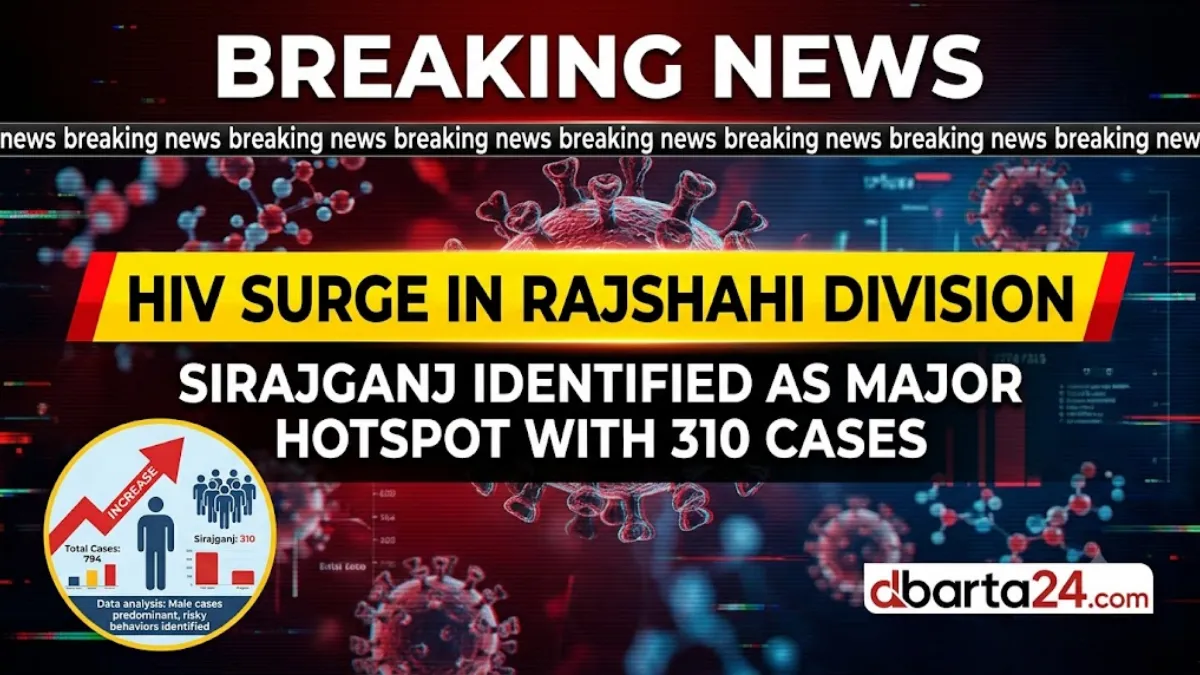
Khairul Alam ; Health Desk — Human Immunodeficiency Virus (HIV) infections are on a worrying trajectory across the Rajshahi division, with the total number of registered cases reaching 794 across eight districts.
Health experts and public health officials have raised alarms over the trend, identifying high-risk sexual behaviors, lack of awareness, social taboos, and underground networks as primary bottlenecks in controlling the spread of the virus.
According to the latest data from the Rajshahi Divisional Directorate General of Health Services (DGHS), Sirajganj district has emerged as the worst-affected area with a staggering 310 cases, while Chapainawabganj recorded the lowest with 21 cases.
District-wise Breakdown of Infections
The distribution of the 794 HIV-positive individuals across the division reveals a widespread challenge:
-
Sirajganj: 310 cases (Highest)
-
Rajshahi: 131 cases
-
Bogura: 109 cases
-
Pabna: 78 cases
-
Naogaon: 65 cases
-
Joypurhat: 37 cases
-
Natore: 43 cases
-
Chapainawabganj: 21 cases (Lowest)
Demographic Analysis: Men and Youth at Highest Risk
Data from the Rajshahi Medical College Hospital (RMCH) shows that out of 12,852 individuals tested between 2019 and March of this year, 115 tested positive for HIV.
The demographic breakdown reveals a stark gender disparity: 105 are male, 9 are female, and 1 identifies as transgender (third gender).
In terms of marital status, 67 individuals are unmarried, while 48 are married. Age-centric statistics indicate that the virus is heavily impacting the economically active population, with 80 patients aged between 25 and 50 years, and 35 patients belonging to the youth demographic of 15 to 24 years. Additionally, four of the infected individuals are migrant returnees.
High-Risk Groups and Transmission Factors
An analysis of the transmission dynamics highlights specific high-risk groups. Among the RMCH-identified cases, 58 contracted the virus through homosexual contact, 35 through interactions with sex workers, 2 are tuberculosis patients, 1 is a sex worker, 2 belong to the transgender community, and 14 are from the general population.
Furthermore, civil surgeon offices and hospital data uncovered an additional 34 cases outside the core testing pool, all of whom are homosexual men and transgender individuals.
Within this subgroup, 31 are male, 3 are transgender, 25 are married, and 25 are over the age of 25.
Dr. Md. Mehedi Hasan Bhuiyan, Assistant Registrar (Medicine) at RMCH, explained the clinical risks behind these numbers:
“HIV infections have been rising nationwide over the last few years. The risk of transmission is notably higher among men who have sex with men (MSM), particularly for receptive partners, as mucosal tears can easily occur, exponentially increasing the risk of viral entry.”
Dr. Ibrahim Md. Sharaf, Focal Person at the RMCH HIV Testing and Counseling Center, echoed these concerns, stating, “Infections are driving upward primarily due to sexual behavior.
The detection rate is significantly high among homosexual individuals, alongside an alarming rate among those visiting brothels.”
Social Stigma and the Need for Awareness
Public health advocates emphasize that fighting the epidemic requires dismantling the social stigma attached to the disease.
S N Abdullah Al Reza, Project Manager of ‘Aparajeyo’ (an organization working with HIV patients), pointed out the psychological toll on patients.
“Families, society, and state mechanisms still view HIV-positive individuals through a negative lens, leaving them mentally devastated. People must understand that HIV is not exclusively a sexually transmitted disease; it can be contracted through various other means,” he said.
Socio-religious perspectives also highlight the community’s concern. Professor Dr. Muhammad Shafiqul Islam, Chairman of the Islamic Studies Department at Rajshahi University, commented, “From an Islamic viewpoint, homosexuality represents severe moral degradation and goes against human nature. It not only violates religious values but also weakens the social family structure and moral fabric.”
A patient, speaking on the condition of anonymity, shared a poignant warning:
“I contracted HIV due to a lack of awareness and risky behavior, and it has now advanced to AIDS. It is vital to raise social awareness. So many people are still completely unaware of the risks and consequences of this disease.”
As the numbers continue to climb, academic and youth voices are calling for immediate intervention. Mahafuza Rahat Bushra, a student at the Barind College of Nursing Sciences, noted that the HIV surge is no longer just a health issue, but a brewing humanitarian crisis.
For health authorities in the Rajshahi division, the path forward requires a delicate balance of scaled-up targeted testing, non-discriminatory healthcare access, and massive public awareness campaigns to shatter the silence surrounding the disease.