


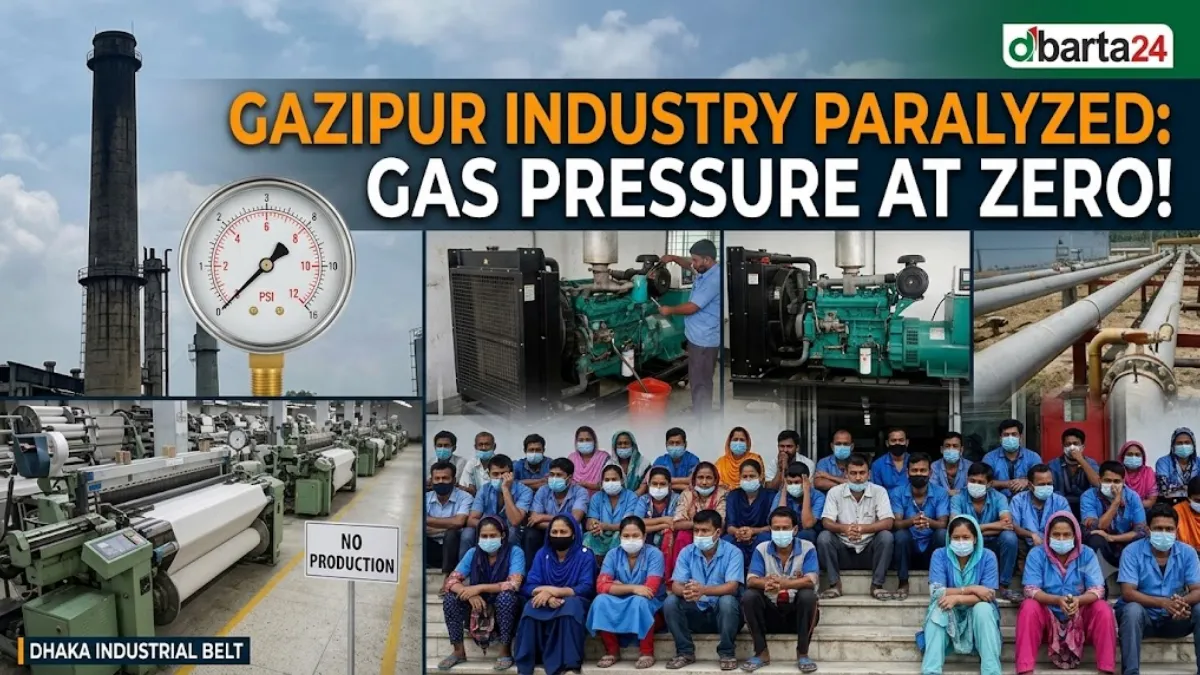
Gazipur Correspondent ; Dbarta24 — A severe gas crisis has brought manufacturing to a virtual standstill across Gazipur, Bangladesh’s primary industrial belt.
With gas pressure dropping to near-zero levels, dozens of textile and readymade garment (RMG) factories have been forced to suspend operations, leaving thousands of workers idle and threatening massive financial losses for factory owners.
Until last week, production lines in industrial zones like Sofipur, Mouchak, Konabari, and Tongi hummed with round-the-clock worker activity. Today, many of these facilities sit in eerie silence as utility lines fail to deliver the basic fuel pressure required to run heavy machinery.
Workers Left Idle as Major Units Cease Operations
At Gomati Textile in Sofipur, all major sections—including textile, dyeing, and knitting—have been shut down since July 19. Roughly 2,500 employees now report to work only to punch their digital attendance cards and leave.
“There is simply no gas in the pipeline—it has hit absolute zero,” said Md. Farhad Hossain, Human Resources Officer at Gomati Textile. “Initially, we managed to purchase alternative fuel on our own to keep the plant afloat, but that proved unsustainable. Consequently, we had no choice but to shut down.”
A similar crisis has unfolded at Sadma Fashion Wear Limited in the Mouchak area, where nearly 7,000 workers are effectively out of work as output has plummeted by 70 percent.
Sohel Rana, Managing Director of Sadma Fashion Wear, explained that running the machinery safely requires a minimum pressure of 4 PSI (pounds per square inch). “Since Monday morning, we haven’t received even 1 PSI,” Rana noted. “Shutting down production is the only remaining option.”
Other units, such as Tapas PN Factory in the Ambagh area, employing 2,000 workers, have likewise been forced to halt operations entirely.
GAZIPUR INDUSTRIAL GAS CRISIS AT A GLANCE
┌─────────────────────────────┬──────────────────────────────┐
│ Daily Gas Demand            │ ~590 Million Cubic Feet      │
│ Daily Supply Received       │ ~300 Million Cubic Feet      │
│ Supply Deficit              │ ~49% Shortfall               │
│ Standard Pressure Needed    │ 10 - 15 PSI                  │
│ Actual Current Pressure     │ 0 - 3 PSI                    │
└─────────────────────────────┴──────────────────────────────┘
Soaring Operational Expenses via Diesel Backup
To avoid total breach of international buyer contracts, larger conglomerates have resorted to running industrial generators on diesel, though at exorbitant costs.
Tusuka Group, located in the Konabari district, has kept its production lines open solely through backup diesel power. Tareq Hasan, Director of Tusuka Group, revealed that the company is spending an extra BDT 2 million (20 lakh) every single day just to keep five high-capacity generators operational.
Industrialists estimate that overall production across Gazipur’s 3,500-plus factories has dropped below 50 percent. Small and medium-sized enterprises (SMEs) are taking the brunt of the shock, with at least 50 facilities shuttering production completely.
Authorities Acknowledge Massive Supply Deficit
Local regulatory and law enforcement authorities admit the situation is critical, though exact metrics on total shut plants remain difficult to trace.
Engr. M. M. Mamun-or-Rashid, Deputy Inspector General of the Gazipur Department of Inspection for Factories and Establishments, acknowledged the pervasive crisis but noted his office lacked an exact headcount of affected factories.
Similarly, Md. Amjad Hossain, Superintendent of Gazipur Industrial Police-2, stated that police forces are maintaining constant monitoring over the situation, though the fluid nature of the crisis makes precise data collection challenging.
Labor leaders have warned that the fallout reaches far beyond business owners. Ashraful Zaman, Central Organizational Secretary of the National Garments Workers Federation, stressed that workers face severe economic insecurity and potential wage disruption as production lines remain frozen.
Providing the official supply statistics, Engr. Md. Golam Faruk, Manager (Operations) of Titas Gas Gazipur Zone, confirmed a stark imbalance between supply and demand.
“The daily demand for gas across the district and city corporation stands at approximately 590 million cubic feet,” Faruk stated. “However, we are receiving only about 300 million cubic feet.”
A Sector in Peril
With Titas Gas delivering barely half of the region’s requirement, factory owners urge immediate government intervention.
As order deadlines loom for international apparel brands, the industrial sector warns that without an immediate restoration of line pressure, the economic shockwaves will spread far beyond Gazipur.