


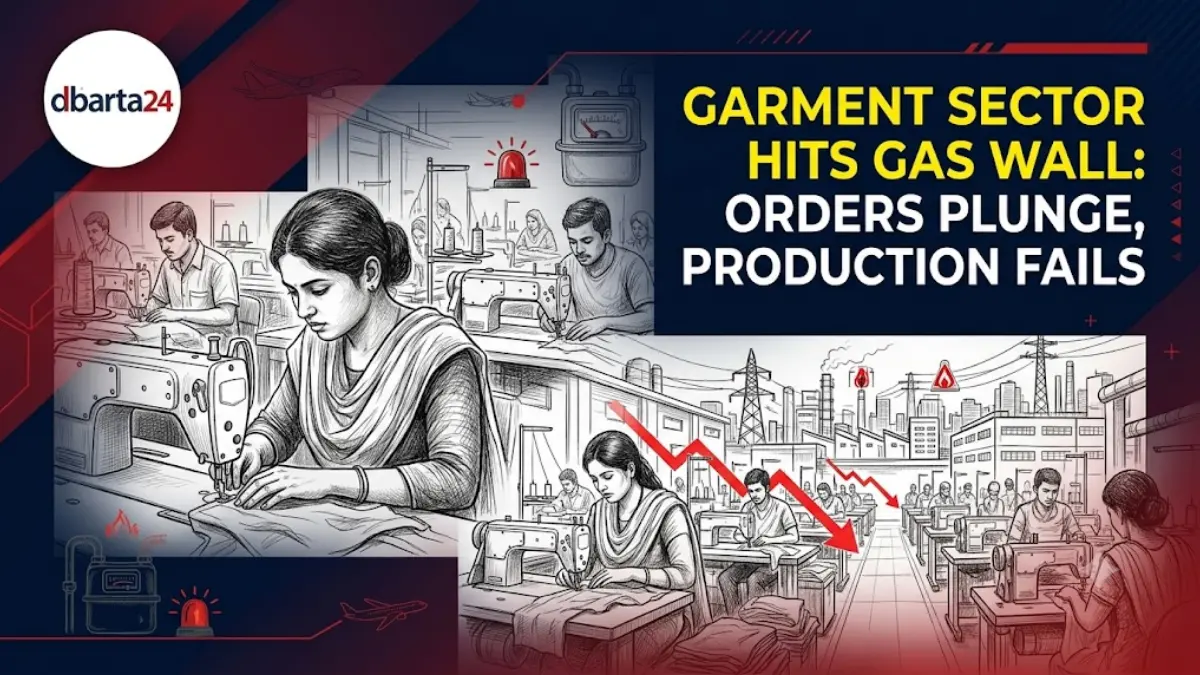
Rahman Ataur; Dbarta24 — A deepening natural gas shortage across Bangladesh’s industrial hubs has severely disrupted the country’s flagship Ready-Made Garment (RMG) and textile sectors, threatening to derail export growth and erode international buyer confidence.
Nearly 1,000 garment factories across key industrial zones—including Dhaka, Gazipur, Narayanganj, Savar, Ashulia, and Mymensingh—are operating far below capacity or facing near-total shutdowns, according to industry leaders.
The acute energy crunch has forced manufacturers to miss shipment deadlines, incur heavy losses through expensive air freight, and turn down fresh export orders.
Factory Floor Realities
At Interlock BD, a garment manufacturing unit in Gazipur’s National University area that supplies major European brands, production has come to a virtual standstill.
Over the past fortnight, the facility was forced to close for five days due to zero gas pressure. Even on operational days, output has plummeted by nearly 60 percent.
“We tried running operations at a 30 percent reduced capacity using expensive alternative gas from CNG stations, but over the last two weeks, no gas has been available from any source,” said Kefaetullah Shakil, Head of Operations at Interlock BD.
“Because garment manufacturing relies on a continuous supply chain, a halt at one stage freezes the entire process. Over the past month, we had to airlift shipments five times, causing massive financial losses and risking buyer trust.”
Similar distress is visible in Narayanganj, where AB Fashion recently had to slash an order of 100,000 trousers for a French buyer by half, citing an inability to meet manufacturing timelines under current energy constraints.
To cope with the shortage, several factory owners have announced temporary shut-downs, aligning factory closures with public holidays to minimize operational losses while continuing to pay basic worker wages.
Textile Supply Chain Breakdown
The crisis is particularly severe in the knitwear segment, which relies almost entirely on domestic textile mills for fabric supply. Without adequate gas pressure, local textile mills cannot run essential dyeing and finishing processes.
Mohammad Hatem, President of the Bangladesh Knitwear Manufacturers and Exporters Association (BKMEA), warned that failure to deliver shipments on schedule risks contract cancellations and severe price discounts.
“If we cannot deliver on time, buyers lose faith. Even if we manage to produce items later, buyers demand discounted prices, or we are forced to bear the massive cost of air freight,” Hatem stated. “Unaccepted goods eventually have to be dumped in the local market as stock lots at a fraction of their value.”
Echoing these concerns, Showkat Aziz Russell, President of the Bangladesh Textile Mills Association (BTMA), described the situation as a national emergency.
“Gas shortages in industry have turned into a national disaster. The government should declare it as such immediately,” Russell said. He highlighted that over the past two years, 150 textile mills have shut down, with remaining units operating at under 60 percent capacity. “Due to policy missteps, Bangladesh imported 30,000 crore BDT worth of yarn from India last year alone, turning a self-reliant sector into an import-dependent one.”
Export Orders Decline Amid Buyer Uncertainty
International fashion brands are monitoring the situation closely. According to data regarding Utilization Declaration (UD) certificates—issued by BGMEA and BKMEA to track raw material imports for upcoming orders—export orders dropped by nearly 3 percent in July compared to the previous month.
Despite the setback, the Bangladesh Garment Manufacturers and Exporters Association (BGMEA) noted that the sector generated $3.89 billion in export earnings in July, demonstrating resilience despite severe geopolitical and domestic headwinds.
In an official statement, BGMEA President Mahmud Hasan Khan emphasized that resolving energy insecurity remains the single most critical factor for restoring buyer confidence and sustaining growth in the coming months.
If gas supply is not restored promptly, industry experts warn that the ongoing stagnation could spill over into the banking, insurance, and broader macroeconomic sectors, undermining Bangladesh’s primary source of foreign exchange earnings.