


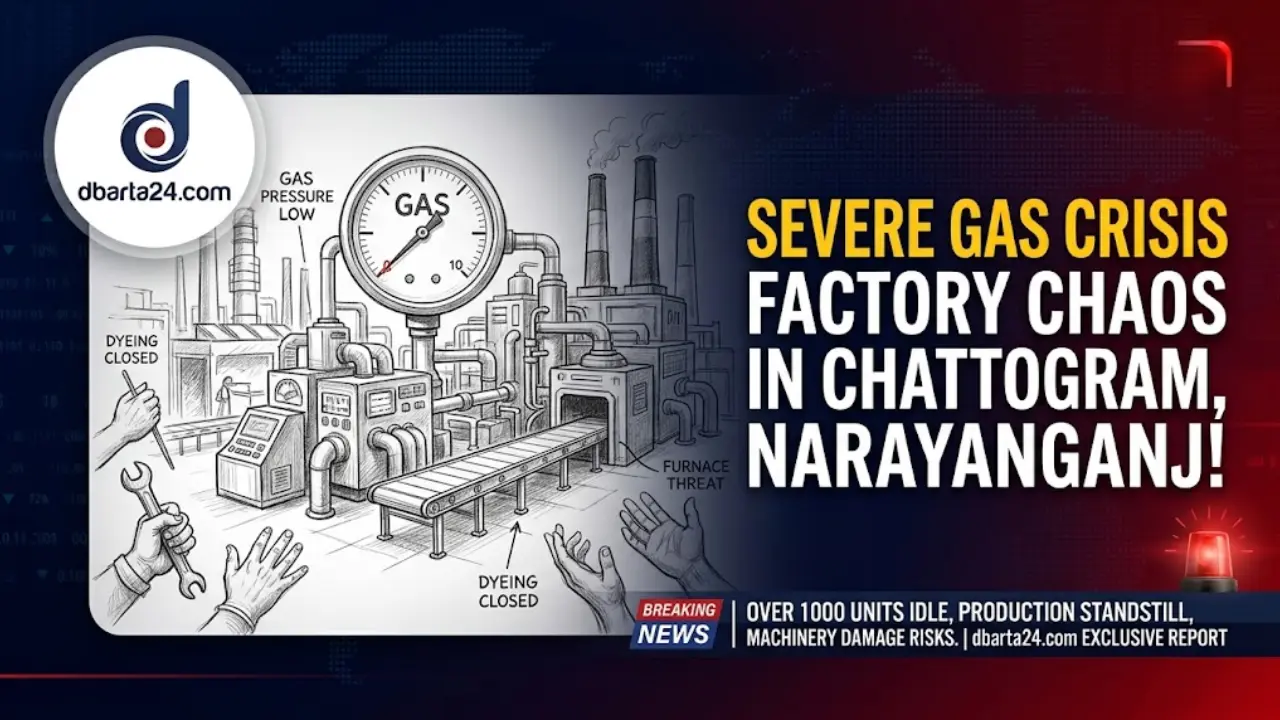
CHATTOGRAM & NARAYANGANJ Correspondent; Dbarta24 — A crippling national gas shortage has brought industrial activity to a virtual standstill across major manufacturing hubs in Bangladesh, forcing over 1,000 heavy industrial plants, steel mills, and Readymade Garments (RMG) factories to shut down or sharply reduce operations.
The severe drop in gas pressure has hit key industrial belts in Chattogram, Narayanganj, and Habiganj, jeopardizing daily production targets, escalating manufacturing costs, and risking catastrophic long-term damage to expensive industrial machinery.
Heavy Industry Reaches a Standstill in Chattogram
In Chattogram, more than 100 gas-dependent heavy industrial units—spanning steel, glass, edible oil, and oxygen production—are facing an unprecedented operational breakdown.
Steel giant BSRM Group, which typically produces around 8,000 tons of raw materials daily, has been forced to suspend raw material manufacturing entirely due to the absence of adequate gas supply.
Other major players, such as HM Steel, have suspended their daytime shifts entirely, running a single unit at night when gas pressure slightly recovers.
“When gas pressure drops drastically, keeping the factory running becomes almost impossible. Operating under such conditions damages expensive machinery, forcing many of us to shut down,” said Tapan Sen Gupta, Deputy Managing Director of BSRM Group.
Sarwar Alam, Director of HM Steel, highlighted the operational strain: “Our Golden Steel plant is completely shut down. At HM Steel, we are forced to keep two daytime shifts closed, attempting to cope by operating just one shift at night when pressure slightly improves.”
Tariq Ahmed, Director of TK Group, added: “Our Karnaphuli Steel has a monthly capacity of nearly 18,000 tons. We had minimal output on Wednesday, but production was zero over the last two days. We do not know how long this will persist, but business owners urgently need clear answers and immediate alternative solutions from the government.”
The crisis poses an existential threat to glass manufacturers like PHP Float Glass Industries. Unlike steel mills, glass furnaces operate continuously on natural gas for over a decade.
If a furnace cools down completely due to gas deprivation, it cannot be restarted; it must be demolished and rebuilt from scratch at a cost of hundreds of millions of Taka.
“With insufficient gas, we are barely keeping our burners lit using minimal electricity from PDB. If a furnace shuts down completely, rebuilding it will take nearly a year and require hundreds of crores in new investment,” explained a senior official from PHP Float Glass Industries.Narayanganj RMG and Linkage Sectors Face Collapse
In Narayanganj, the heartbeat of Bangladesh’s knitwear and textile production, nearly 1,000 factories—including RMG units, dyeing facilities, salt refineries, and re-rolling mills—have ceased operations over the past two to three days.
“Our dyeing unit has been shut since July 23 due to low gas pressure. We managed to keep garment assembly running using stocked fabric, but yesterday our inventory ran out completely. As a result, factory production has fully stopped,” stated Minhajul Haq, Director of Fatullah Garments.
Mohammad Hatem, President of the Bangladesh Knitwear Manufacturers and Exporters Association (BKMEA), warned of a broader collapse: “Around 500 of our member garments in Narayanganj, along with linkage industries like dyeing and sub-contracting units, are shut. If this situation does not improve rapidly, the entire RMG sector faces a potential disaster.”
The crisis is compounded by severe electricity load-shedding triggered by the gas shortage, which has disrupted electricity-driven knitting mills that rely on captive power generators.
Amjad Hossain, President of the Bangladesh Knit Dyeing Owners Association, confirmed that almost all 150 member factories are currently inactive due to the gas drought.Export Hubs in Habiganj Forced into Shutdown
The crisis has extended into the northeastern industrial corridor of Habiganj. In the Madhabpur and Shahjibazar industrial zones, gas pressure dropped close to zero, causing major export-oriented groups—including Sayham Denim, PRAN-RFL, Square Textiles, RAK Ceramics, Jamuna Group, and Akij—to halt production or run on emergency power sources.
Abdul Mazed, General Manager of Square Denims, reported: “Gas supply stopped completely on Wednesday afternoon. A facility employing 3,000 workers is currently under a complete shutdown.”
Mohammad Khaled Gani, Manager at Shahjibazar Office of Jalalabad Gas Transmission and Distribution System Ltd (JGTDSL), expressed local limitations: “Factory owners are constantly reaching out, but because this is a national-level supply shortage, we cannot resolve it locally. The situation is unlikely to normalize over the next few days.”Economic Fallout and The Path Ahead
Economic experts and trade leaders urge immediate strategic interventions, emphasizing that a protracted shutdown will hurt not only individual enterprises but also national export earnings and supply chains.
Amirul Haq, President of the Chattogram Chamber of Commerce and Industry, emphasized: “Disruptions in gas supply to factories will not remain confined to local business losses—they will severely impact the national economy. The government must formulate robust mid-to-long-term energy management plans.”
While representatives from Jalalabad Gas T&D System Ltd expressed hope that supply conditions might see minor improvements within three to four days, industrial leaders stress that urgent, temporary relief mechanisms are vital to keep the country’s manufacturing engine from grinding to a permanent halt.