


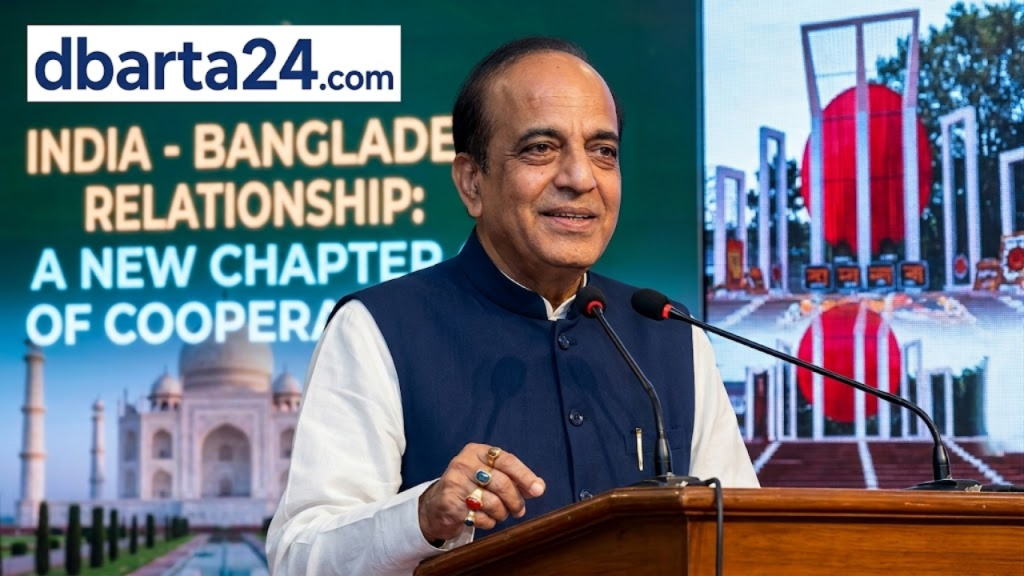
Khairul Alam ; DHAKA – Breaking a five-decade-old tradition of relying on career bureaucrats, the Narendra Modi government is set to appoint a veteran politician as India’s High Commissioner to Bangladesh.
Dinesh Trivedi, a former Union Railway Minister and BJP leader, is expected to become the first “political appointee” to lead the mission in Dhaka.
Breaking the Bureaucratic Mold
Historically, India has always sent senior Indian Foreign Service (IFS) officers—such as Harsh Vardhan Shringla or Vikram Doraiswami—to Dhaka.
However, New Delhi now believes that the shifting political landscape in Bangladesh requires “political wisdom” over “diplomatic protocol.”
The decision comes after the recent general elections in Bangladesh, where the BNP (Bangladesh Nationalist Party) emerged victorious.
Reports suggest that some in New Delhi feel career diplomats were unable to accurately gauge the grassroots political shift away from the Awami League, prompting this “course correction.”
The Three Pillars of Trivedi’s Appointment
1. Breaking the “One-Party Friend” Perception
For 15 years, India shared an exclusive closeness with the Awami League. Analysts suggest this created a perception among the Bangladeshi public that India was a friend to only one party.
By sending a high-profile politician like Trivedi, Delhi aims to signal that it is committed to a state-to-state relationship with Bangladesh, regardless of who is in power.
2. The West Bengal Factor
Trivedi’s linguistic and cultural roots in West Bengal are seen as a strategic “Trump Card.” Fluent in Bengali and deeply familiar with the region’s culture, Trivedi can bridge the gap between Dhaka, New Delhi, and Kolkata.
His background helps him navigate sensitive issues like the Teesta Water Sharing Treaty and border killings, where West Bengal’s state politics play a decisive role.
3. Direct Political Dialogue
While diplomats work behind the scenes and follow rigid protocols, a politician can engage in direct, “table-to-table” conversations.
Trivedi’s experience allows him to bypass bureaucratic hurdles to address India’s security concerns—such as regional stability and extremism—through personal rapport and political negotiation.
A Historic Precedent
India has used political appointments sparingly to fix strained ties, such as sending General S.K. Sinha to Nepal in 1990. Appointing a politician to Dhaka now signifies that India considers Bangladesh its most critical geopolitical “hotspot” in South Asia.
Challenges Ahead
Trivedi’s primary task will be to mitigate public resentment and negative perceptions of India in Bangladesh. He must transform the relationship from “Auto-Pilot” mode to an active, mutually beneficial partnership.
As Dhaka prepares to provide its formal consent (Agreemant), all eyes are on how this blend of political pragmatism and diplomatic necessity will reshape Delhi-Dhaka ties
Comparative Table: Professional vs. Political Diplomacy
| Feature | Career Diplomat (IFS) | Political Appointee |
| Primary Strength | Protocol and Bureaucracy | Personal Rapport and Vision |
| Communication | Formal/Official Channels | Direct Political Dialogue |
| Risk Factor | May miss grassroots shifts | May lack administrative nuance |
| Objective | Stability and Continuity | Strategic Reform and Trust Building |